


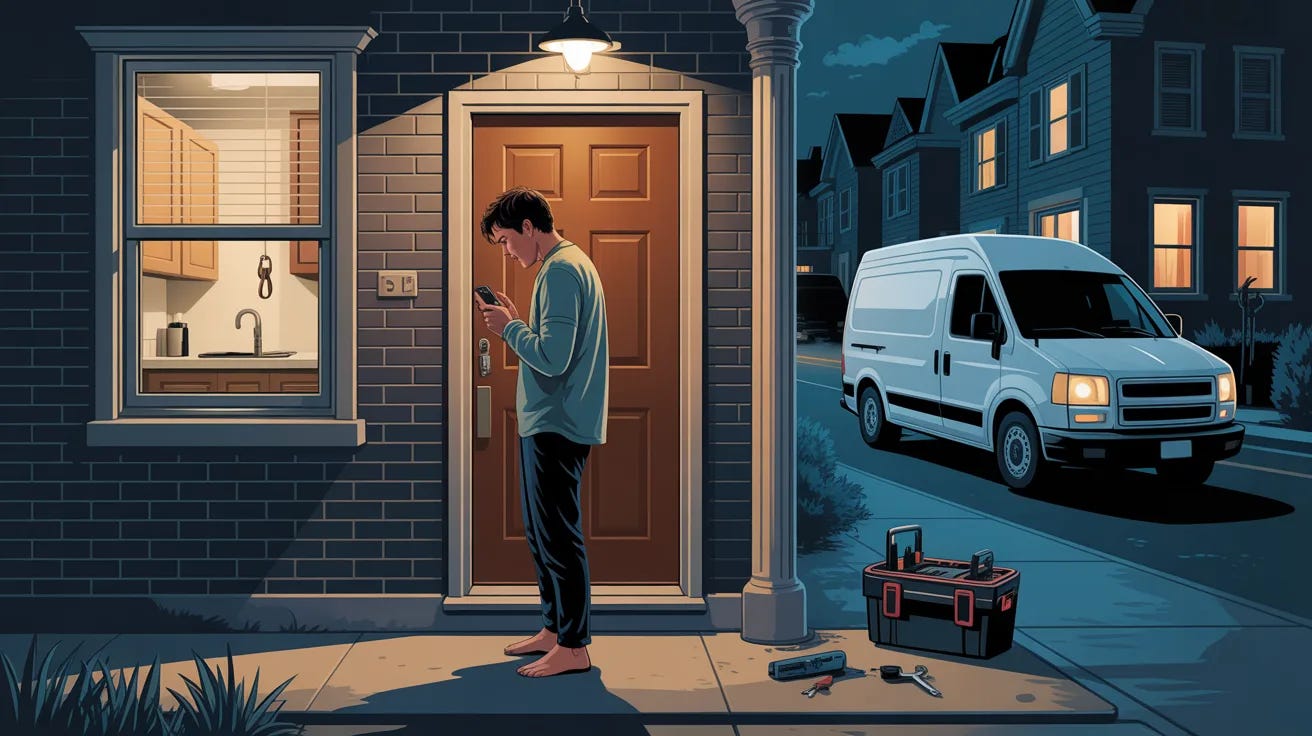
The locksmith showed up 40 minutes late.
You were standing outside your apartment in Atlanta at 11pm on a Tuesday. Barefoot.
Phone at 4%. Your keys sitting on the kitchen counter, visible through the window you couldn’t open.
He pulled up in a van with no signage. Looked at your door for about six seconds. Pulled out a tool. Had it open in under a minute.
“That’ll be $285.”
You paid it. Of course you paid it. What were you going to do, sleep on the sidewalk?
Two days later, you found the spare key. It was in your gym bag the whole time. Right there in the front pocket, exactly where you put it six months ago “just in case.”
You didn’t need a locksmith. You needed to check your bag.
The $285 wasn’t the cost of getting locked out. It was the cost of not finishing what you started when you made the spare in the first place.
Your DM follow-up list works the same way.
You have 14 names on it right now. You’re sending bridge messages, check-ins, value drops, nudges. You’re spending hours every week trying to re-open doors that never actually closed.
But half of those people aren’t on your list because they need more time. They’re on your list because the conversation stopped before it should have. You had the key in your bag. You just didn’t check.
Today, I’m sharing the 3 shifts that separate coaches who chase 14 people and close 3... from coaches who follow up with 4 people and close 3.
→ Why “let me think about it” is actually three different situations disguised as one sentence, and how treating them the same is doubling your follow-up workload
→ The one question most coaches skip that turns a closeable conversation into a follow-up task
→ How to shrink your follow-up list to only the people who belong on it, so every message you send actually matters
Let’s talk about why your follow-up list is lying to you...
Here’s the thing nobody tells you about follow-up: the system isn’t broken. The list is bloated.
You have people on there who legitimately need time. You have people who were never going to buy. And you have people who could have decided in the conversation if you’d asked one more question.
All three look identical on your list. All three get the same messages. And that’s why your follow-up feels like pushing a boulder uphill.
Here are the 3 shifts that shrink your follow-up list to only the right people.
1️⃣ From “everyone who says ‘let me think about it’ needs follow-up” to “some of them needed one more question, not one more message later”
You just wrapped a 20-minute DM conversation. It went well. They asked good questions. You gave real answers. Then they typed it:
“This sounds great. Let me think about it and get back to you.”
You add them to your follow-up list.
You schedule a bridge message for six hours.
A value-add for 24.
A nudge for 72.
Same sequence you use for everyone.
But “let me think about it” isn’t one thing. It’s 3 different things wearing the same sentence.
→ The Legitimate Pause: they have a real external factor. A spouse to consult, a budget to rearrange, a contract ending next month. This is genuine. Follow up.
→ The Polite Exit: they’re not interested but don’t want to say it. This is done. Let it go.
→ The Conviction Gap: they’re interested but something didn’t land. A concern went unnamed. The cost of staying stuck wasn’t felt deeply enough. Your offer made sense but didn’t feel urgent.
Most coaches treat all three identically. Same follow-up cadence. Same “just checking in.” Same energy spent.
Before you add someone to your follow-up list, ask yourself which of the three you’re looking at. Because the Conviction Gap isn’t a follow-up problem. It’s a conversation problem that already happened.
❌ Before: “She said she needs to think about it” → adds to follow-up list → sends bridge message in 6 hours → sends value-add at 24 hours → sends nudge at 72 hours
✅ After: “She said she needs to think about it” → asks “Was there a real external factor, or did I leave something unresolved?” → if Conviction Gap, the fix is in the NEXT conversation, not in chasing this one
2️⃣ From “I don’t want to be too salesy” to “my fear of being direct is what’s creating half my follow-up workload”
It’s 9pm. You’re scrolling back through a DM conversation from earlier today.
The prospect was engaged. They asked about your process. They shared their biggest struggle. Everything was moving.
Then you felt them hesitate. A slightly shorter reply. A pause before responding. And instead of asking “what’s the hesitation?” you typed “no pressure, take your time.”
That phrase feels generous. It also just created a follow-up task that didn’t need to exist.
You weren’t being respectful. You were being uncomfortable.
And that discomfort just generated 3-5 more messages you’ll send over the next week trying to recover a conversation that could have been completed in 2 more minutes.
This isn’t about being pushy. It’s about understanding that every question you don’t ask in the conversation becomes a follow-up message you have to send later.
The math is simple: one uncomfortable question now, or five comfortable messages later that probably don’t work.
❌ Before: “I gave her space because I respect her process” → 5 follow-up messages over 2 weeks → no response → moves to cold list
✅ After: “I asked ‘what’s the part you’re not sure about?’ because I respect her time” → she names the concern → you address it → she either decides or tells you the REAL timeline → your follow-up list shrinks by one
3️⃣ From “I need a better follow-up system” to “I need my follow-up list to only contain people who actually belong on it”
You’re looking at your CRM on a Sunday night.
14 names in your “active follow-up” pipeline. You’ve been sending messages to all of them for weeks. You’ve closed 3 this month.
Your first thought: “I need better follow-up sequences.”
Your real problem: the list is full of people who don’t belong on it.
The coaches who seem effortless at follow-up aren’t better at chasing. They just have fewer people to chase.
Their conversations do more work upfront, so the follow-up list is smaller, more qualified, and higher-converting.
They’re not sending fewer messages because they’re lazy. They’re sending fewer messages because most of their prospects decided in the conversation... yes or no... and only the legitimate “I need a week to sort out my budget” people made the list.
❌ Before: Follow-up list of 14 → close 3 → 21% conversion → “I need better follow-up sequences”
✅ After: Conversation completion reduces list to 6 (4 legitimate pauses + 2 you’re testing) → close 3 → 50% conversion → same revenue, half the chase
That’s it.
Here’s what you learned today:
→ “Let me think about it” is three different situations. The Legitimate Pause, the Polite Exit, and the Conviction Gap. Treating all three the same doubles your workload for no reason.
→ Your fear of being direct isn’t protecting the relationship. It’s creating follow-up tasks. One honest question in the conversation saves you five awkward messages later.
→ You don’t need a better follow-up system. You need a smaller, cleaner follow-up list where every name has a real reason to be there.
After your next DM conversation, before you add that person to your follow-up list, ask yourself... “Is this a Legitimate Pause, a Polite Exit, or a Conviction Gap?” Your answer changes everything about what you do next.
Ready to stop chasing conversations you could have closed?
You’re not bad at follow-up... but your follow-up list is full of people who shouldn’t be on it.
Today’s paid member mega-prompt diagnoses exactly where your conversations are creating unnecessary follow-up...and shows you how to fix it.
Paid members get:
✔ A Conviction Gap Audit for any DM conversation you paste in
→ Identifies whether it was a Legitimate Pause, Polite Exit, or Conviction Gap
→ Pinpoints the exact moment certainty broke in the conversation
✔ A rewritten version of just that section showing what completing the conversation would have looked like
✔ If it IS a Legitimate Pause... the right follow-up message and timing based on what they actually told you
