


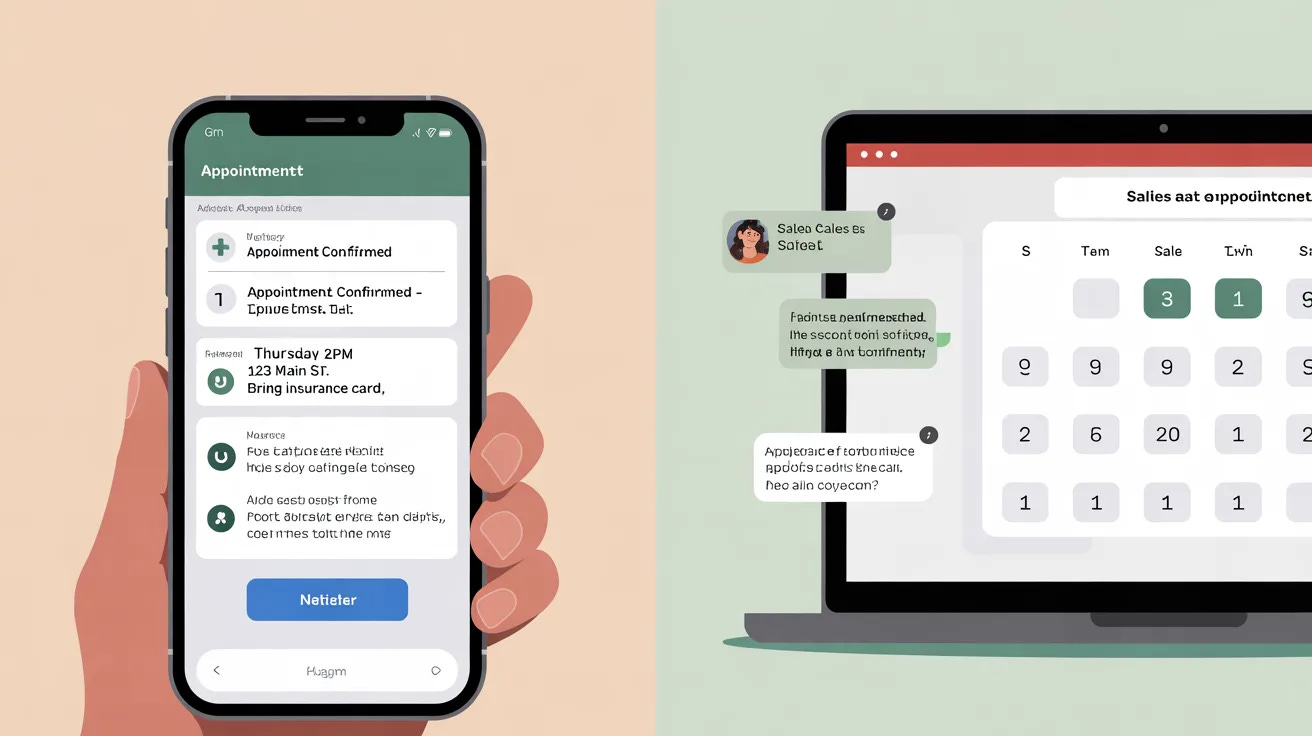
You book a doctor’s appointment online.
Within 30 seconds, you get a confirmation email.
Date, time, address, what to bring.
Two days before, a text: “Reminder: appointment Thursday at 2pm. Reply C to confirm.”
Two hours before, another one. The address again. A link to check in early.
You don’t have to remember anything. You don’t have to wonder if it’s still happening. The system closes every gap between “booked” and “showed up.”
Now think about what happens when a prospect says yes to a call through a DM convo with your setter.
In most cases, your setter sends a Calendly link, and then... silence.
Five days pass. The prospect opens their calendar Thursday morning, sees a call they barely remember agreeing to, scrolls back through their DMs looking for details, and closes the laptop.
Your doctor’s office has a better show rate than your sales team… and they’re not even selling anything.
I’ve spent most of the last 11 days showing you what was broken in the DM funnel my friend Reid paid an agency $2K to build for him.
But what about the parts of it that actually work?
What happens when the prospect says yes, and books a call?
Most people focus just on getting to the yes. But what happens after is just as important.
Today, I’m talking about the post-yes fumble. What happens after a prospect agrees to a call and your sequence turns a win into a no-show.
→ Why a naked Calendly link kills the momentum your first four messages built
→ Why “did that link work for you?” is tech support, not sales
→ Why the best setters never wait for the prospect to come back to the thread
Let’s get into it...
The 3 mistakes your setter makes after a prospect books that make or break whether they actually end up on the call with you or your closer.
1️⃣ The naked Calendly drop
Reid’s sequence gets a positive reply. Someone says “sure, I’d be open to chatting.”
The next message in the sequence? A Calendly link. Nothing else.
No context. No framing. No connection to what they just said yes to.
The prospect clicks the link. They see a generic booking page.
There’s a headshot. A 30-minute slot. A description that says “Strategy Call.”
All the emotional momentum from “yes” dies in a scheduling interface.
The prospect didn’t say yes to a Calendly link. They said yes to a conversation about their specific situation. The link drop treats their “yes” like a transaction instead of a turning point.
The fix is simple. Pitch the call wrapped in THEIR transformation.
Not “here’s my calendar.” Something closer to:
“Based on what you mentioned about [their specific challenge], I think a quick call would be the fastest way to map out how [specific outcome] would work for your setup. That’s hard to do fully in DMs, but I can walk you through it in about 20 minutes.”
Then drop the link. The link comes after the frame, not instead of it.
And add the anchor. One line after the link that creates a reason for the prospect to come back to the thread:
“Once you’ve grabbed a time, let me know here so I can get your info prepped before the call.”
That anchor does two things:
It gives the prospect a reason to return to the DM thread after booking.
And it gives the setter a signal that the booking happened without having to manually check Calendly or Slack every hour.
2️⃣ The tech-support follow-up
The prospect doesn’t book immediately after the Calendly drop. Reid’s next message?
“Did that link work for you?”
Read that again. The prospect said yes to a conversation about their business. The next thing they hear is someone troubleshooting a URL.
This reframes the prospect’s silence as a technical problem. Maybe they didn’t book because the link was broken. Or maybe they didn’t book because nothing in the link-drop message gave them a reason to. The sequence assumes the only explanation for not booking is a malfunctioning hyperlink.
The real question isn’t “did the link work.” The real question is “did I give them enough reason to click it.”
If the setter wrapped the call in the prospect’s transformation and added the anchor, the follow-up looks completely different.
Instead of troubleshooting, the setter is checking in with context:
“Hey, saw you hadn’t grabbed a time yet. Totally understand if the week’s been packed. Wanted to see if that link worked for you? I know LinkedIn has been a little glitchy when it comes to links these days.”
That’s a human following up. Not a help desk.
3️⃣ The one-word last touch
Reid’s final message after the Calendly drop and the tech-support follow-up?
“[FIRST NAME]?”
One word. One question mark. The most desperate message in any DM sequence.
The prospect went from “sure, I’m interested” to receiving three messages that were all about logistics…
A scheduling link. A tech check. And now their first name with a question mark, as if they owe someone an explanation for not booking yet.
The fork your sequence needs (and probably doesn’t have)
Here’s what should actually happen after a prospect books.
There are two paths. Both end in the same place. The setter’s behavior is different depending on which one fires.
Path A: Prospect comes back and confirms they booked.
This happens roughly half the time. The prospect books, then messages back: “just booked for Thursday.”
The setter responds with three things in one message…
Gratitude (genuine, not performative).
A calendar confirmation check (”can you double check you hit yes on the calendar invite?”).
And the Zoom link dropped directly in the DM thread.
Why the Zoom link in the thread? Because that’s where the original conversation lives.
Putting the meeting link where they already are increases the chance they actually click it when Thursday comes.
Path B: Prospect books but doesn’t come back to the thread.
This is the other half. They booked. They didn’t message back. Most setters sit here and wait.
That’s a mistake.
The setter should be watching for new bookings.
Calendly notifications, through Slack alerts, through whatever system surfaces them.
The moment the setter sees the booking, they’re proactive:
“Hey! Saw you were able to find a time with [closer’s name] on [day] at [time].”
Then the same confirmation flow. Calendar check. Zoom link in the thread.
The difference: Path A is reactive. The prospect triggers the confirmation.
Path B is proactive. The setter triggers the confirmation.
The setter who only does Path A misses half their booked calls. They’re waiting for the prospect to come back to a thread the prospect already left.
That’s it.
Here’s what you learned today:
→ A “yes” is the starting line, not the finish line. The gap between “sure, let’s chat” and “showed up to the call” is where most sequences lose people.
→ A Calendly link without context is a transaction. A call pitch wrapped in their transformation is a continuation of the conversation.
→ Your setter should never be waiting for the prospect to come back. The setter watches the system and closes the loop.
Pull up the last 5 times a prospect said yes to a call. Count the touchpoints between “yes” and “showed up.”
If the answer is one (the Calendly link), your show rate is telling you everything you need to know.
Over the next 31 days, I’m walking you through:
→ What happens when a prospect says yes but doesn’t book (the fork we didn’t take today)
→ How to reframe your entire outreach from “sequence” to “conversation”
→ The difference between a message that earns a reply and one that earns an archive
→ Why your follow-up messages are doing more damage than your opener
→ The 3 questions every prospect is silently asking before they reply
→ How to build a DM system your setter can actually run without you in the room
→ Why the best outreach doesn’t feel like outreach
What we’ve already covered:
→ Day 1: How to write a DM opener that doesn’t sound like every other DM opener. The sender-first opener and why “Hey [Name], saw your profile” is dead.
→ Day 2: How to personalize without sounding like a merge tag. The lazy line every prospect has seen 200 times this month.
→ Day 3: How to ask a question your prospect actually wants to answer. The bait-question test.
→ Day 4: How to pass the IKEA test on every message in your sequence. One instruction per message, every time.
→ Day 5: How to stop your prospect from ghosting after M1. The pacing pattern that earns a second touch.
→ Day 6: How to write an M2 that doesn’t look like a follow-up. The reopener that pays off the opening message.
→ Day 7: How to stop booking calls that don’t close. Qualifying inside the DM before the calendar link goes out.
→ Day 8: How to spot the question that wasn’t a question. Spencer’s opening message and the bait under the curiosity.
→ Day 9: The Frame Flip. When “teach me” becomes “let me teach you” in one message.
→ Day 10: The lazy automation. Why your ManyChat flow asks a question it doesn’t use the answer to.
→ Day 11: The Unnecessary Breakup. When the “last message” kills a thread that was still alive.
You can have the best opener in your sequence. The best follow-ups. The best personalization.
But if your post-yes flow isn’t dialed in, you’re still losing the conversion.
Most agency owners spend all their time optimizing what happens before the prospect replies. The opener. The follow-up cadence. The personalization line. But they completely neglect what happens after the prospect says yes.
Which is where the actual revenue lives.
Your setter doesn’t need a better script for getting replies. They need a system for what to do when the reply is “yes.”
I built one.
The Post-Yes Playbook
→ Call Pitch Framework: paste your current call pitch, get it scored on whether it wraps the ask in the prospect’s transformation or just requests a meeting. If it fails, it generates the replacement.
→ Link Drop + Anchor Templates: the exact messages your setter sends when dropping the booking link, with the anchor line that keeps the prospect in the thread.
→ Post-Book Confirmation Flow: both paths. Prospect confirms in thread, prospect books silently. Nothing left to improvise.
→ Worked Examples: real anonymized conversation threads showing the flow in action. The cadence, the language, the timing.
→ Cowork Batch Workflow: paste your current post-yes sequence, get every message scored and rebuilt.
→ Claude Skill File: your setter runs “post-yes audit” before sending any message after a positive reply.
Paid 8am In Atlanta subscribers: use code included with today’s mega-prompt at checkout for $20 off.
Not a paid subscriber yet? Upgrade your subscription to get $20 off this playbook (and every tool I drop in the May Series).
