



Jose was at a marketing conference in Phoenix last year. Front row, taking notes.
The keynote speaker was 18 minutes in. Slide 14 of 36. Talking about “the future of brand resonance,” which is corporate for “I don’t know what to say but I’m contracted to say it for 45 minutes.”
The room had started slipping out during the break. Polite at first. One or two at a time. Then more.
By minute 18, half the seats were empty.
The speaker didn’t notice.
He kept going. Got louder on the second half of slide 14. Started using his hands more. Pivoted into a story he clearly thought was going to land.
The remaining people in the room were on their phones. One guy was actively scrolling Zillow.
The speaker hit the punchline. Nobody laughed. Except for him. He laughed at his own joke. Then powered through to slide 15.
He had 4 more slides where he asked rhetorical questions. “Right?” “You feel me?” “Anyone else?”
Nobody answered. Because nobody was listening. Because nobody was there.
But he was performing to the front row of empty chairs like he had a crowd.
My friend Reid’s DM sequence... the one he paid an agency $2k for... was doing exactly this.
Reid sent message 1. The prospect opened it. Read it. Didn’t reply.
The sequence kept sending. Message 2. Message 3. Message 4. Each one louder.
Each one a little more “just following up.” Each one performed to a prospect who had already left the room by message 2.
Today, I’m diagnosing the silent objection. The thing the prospect didn’t say that made them stop replying, and what your sequence should have done instead of getting louder.
→ The three places sequences get silenced and what each one means
→ Why “just checking in” is the message version of laughing at your own joke
→ How to map the silence point to the right recovery message
Let’s start with the speaker who didn’t notice the room emptied...
🔇 Mistake 21 | Your sequence kept sending when the silence was telling you something
Silence isn’t one thing. There are 3 places a prospect goes quiet in the DMs, and each one means something different.
1️⃣ The cold ghost. They never opened the first message. Or they opened it and didn’t read past the first line.
This silence is usually about the opener, not the offer. They never gave you a chance because the first 12 words didn’t earn it.
Your follow-up should not pretend the conversation started. It should restart the conversation from a different angle.
2️⃣ The warm fade | They opened messages 1 and 2. Maybe even replied to message 1 with a soft “tell me more.” Then nothing.
This silence is usually about something you said that broke the trust. The pricing reveal landed wrong. The “let me send you my calendar link” felt premature. The case study used a competitor they don’t respect.
Your follow-up needs to acknowledge that something specific shifted, not pretend nothing happened.
3️⃣ The polite stall | They replied through message 3. They said things like “let me think on this” or “send me more info.” Then they vanished.
This silence is usually about timing or internal politics. They were curious. Something blocked them. They didn’t want to tell you what.
Your follow-up shouldn’t push for the call again. It should give them a way out that keeps the door open.
Most teams treat all three silences the same way. They send the same “just checking in” message regardless of where the prospect went quiet.
Reid sent 6 “just checking in” messages over 14 days to a prospect who had warm-faded after message 2. He never asked why he faded. Just kept following up louder.
Usually, the founder thinks the issue is persistence. “I just need my setters to follow up more.” But more volume doesn’t always give better results.
They opened your first message. Maybe even read the second.
Then... nothing.
Your team kept sending. Four more messages. Each one ignored. Nobody stopped to ask what the silence was actually saying.
🤖 I built a free DM Sequence Grader that scores your sequence (or existing conversations) across 7 dimensions in under 3 minutes.
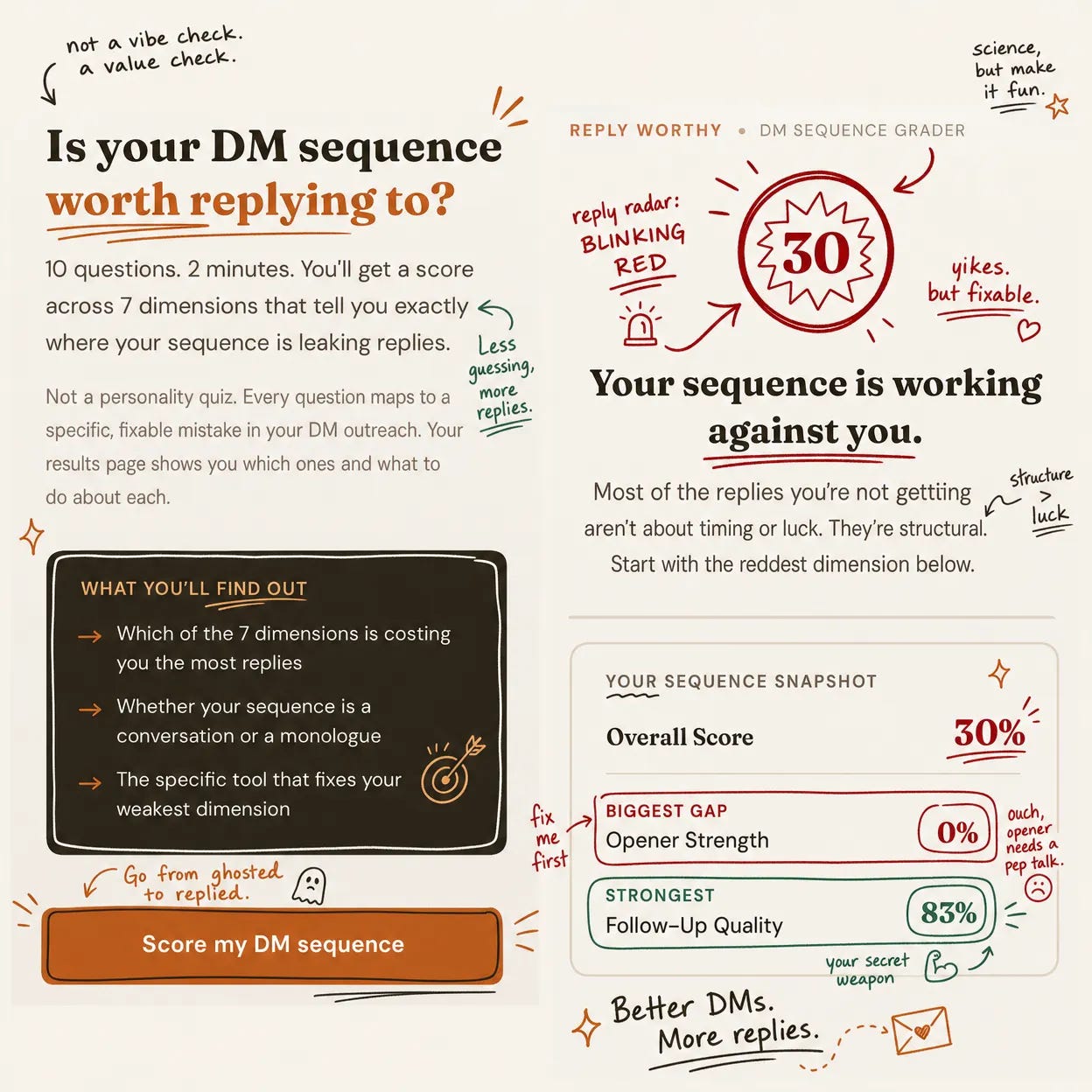
You get a true score, your weakest dimension, and exactly where to start fixing first:
→ Score your DM sequence or last DM conversation for free here
Stop sending louder. Start listening to the silence.
Before & After
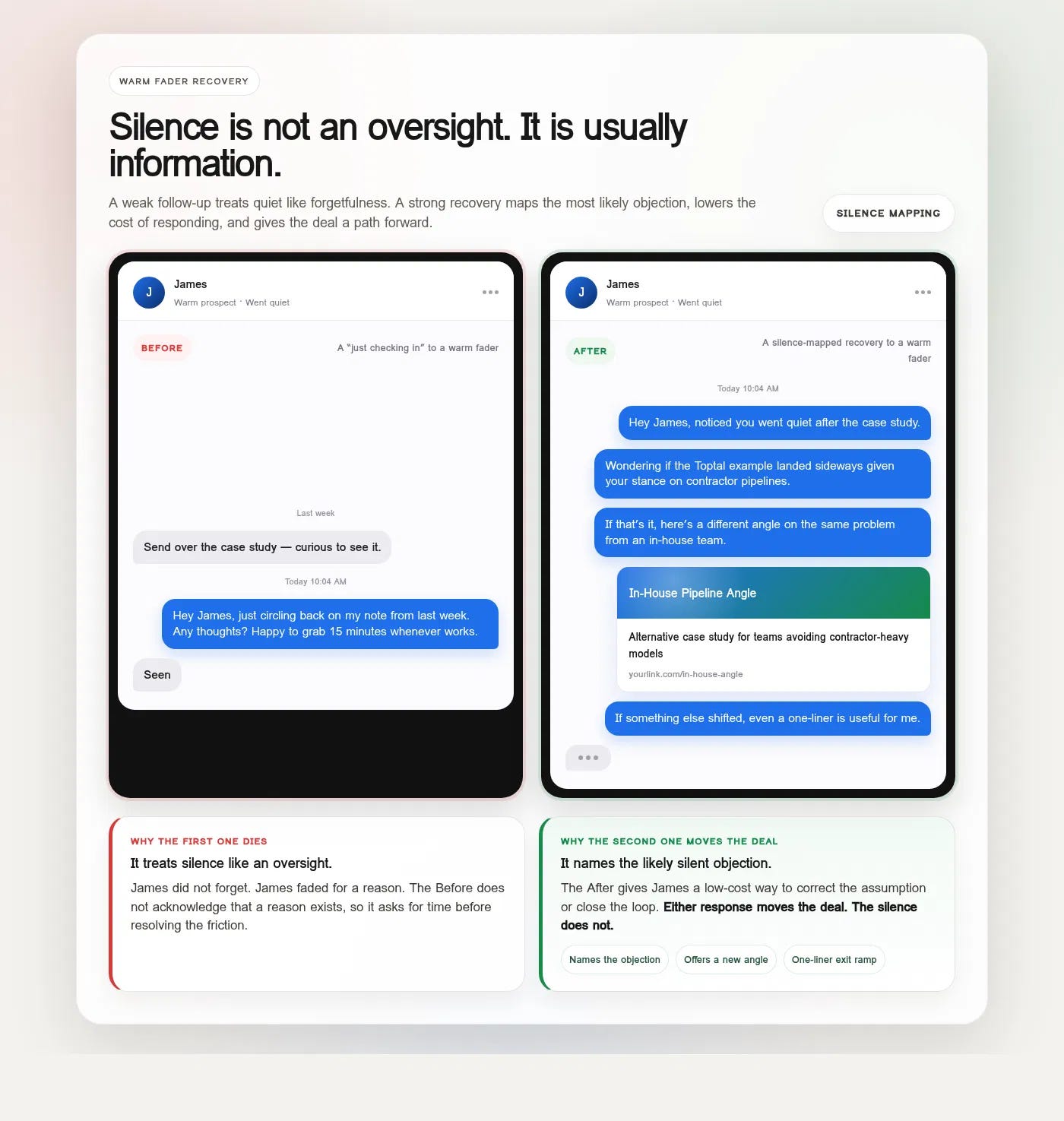
Here’s how to fix it in your own DMs:
1️⃣ Map the silence point before you write the recovery.
Did they ghost cold? Warm fade? Polite stall? You don’t write the same message to all three. Build a one-pager your setter can run: silence type, the most likely cause, the recovery move. 90 seconds of diagnosis saves 6 wasted follow-ups.
2️⃣ Name the most likely silent objection in the recovery message.
The prospect didn’t tell you why they went quiet. Tell them what you suspect, specifically. “I’m guessing the pricing felt premature” beats “just circling back” every time. If you’re wrong, they correct you. The correction is the conversation. The conversation is the recovery.
3️⃣ Give them a way out that keeps the door open.
Reid’s sequence kept asking for the call. After silence, that’s the worst move. Build a “graceful close” message your head of growth can deploy at message 5 or 6: “If now’s not it, no pressure. Want me to circle back next quarter, or close the loop entirely?” The yes-or-no keeps your CRM clean and your future pipeline warmer.
The fix isn’t more follow-ups. It’s the right follow-up to the right silence.
That’s it.
Here’s what you learned today:
→ Silence isn’t one thing. There are three silence types, and each one means something specific.
→ Most sequences treat every silence the same way and send the same “just checking in” to all three.
→ The fix is diagnosing the silence point first, then writing the recovery message that matches.
Start with just one:
Pull up the last DM thread where a prospect went quiet on your team.
Identify the silence type: cold ghost, warm fade, or polite stall.
Write the next message to match that silence type. Not the one your setter would have sent.
Over the next 31 days, I’m walking you through:
→ The map that shows you which of the 7 actual conversation steps your sequence skips
→ How to build the opener from scratch and score it before send
→ How to build the discovery layer that earns the next message
→ How to write a message that creates the “I hadn’t considered that” moment
→ How to write a Value Drop that earns the call without asking for it
→ How to build a recovery system calibrated to WHERE in the sequence they went silent
→ The full sequence assembly, every piece, scored against every diagnostic from the series
Today’s mega-prompt doesn’t just label the silence.
It maps your specific drop-off point to the three most likely unspoken objections at that moment, then generates a recovery message for each.
Paid members get:
✔ The Silent Objection Map
→ Tell it where the prospect went quiet, get back the three most likely silent objections at that exact point
→ Get a paste-ready recovery message for each of the three, calibrated to the silence type
→ See the next-message pattern your sequence should run based on which objection lands
✔ A one-page silence-type diagnostic for your setter to run on every ghosted thread
✔ A graceful close template your team can deploy at message 5 or 6 to keep future pipeline warm
The speaker didn’t notice the room emptied. Your DM sequence is doing the same thing. The chairs are still there. The people aren’t.
