



A friend of mine finally demolished her kitchen last year. She’d been complaining about it for six years.
The tile that was the wrong color. The cabinets that didn’t close all the way. The island that was too small for her family. The lighting that made everything look like a 1997 dental office.
For six years it was a regular conversation. And for six years it stayed exactly the same.
Then she did it. Hired a contractor. Got the permits. Cleared the room.
The day they took the cabinets out she sent me a pic. The kitchen was an empty shell.
Drywall. Exposed pipes. Dust. And the markings where the old island used to sit.
She captioned it: “feels great. now what?” The ‘now what’ is he part people don’t anticipate.
Demolition feels productive. Looks productive. Even sounds productive when somebody asks how the renovation is going.
But the empty debris filled room isn’t the finished kitchen. It’s the very beginning of what comes next.
The 22 days in the series before today were the demolition. We pulled apart the broken opener, the give-to-take gap, the silent objection, the 7 messages that covered 2 steps. We named what was wrong.
The room is empty. Now we build.
Today, I’m walking you through how to build the opener from scratch. Not a template you copy. A construction method your team can run on any prospect in any industry, with the score baked in before send.
→ The three jobs an opener has to do and how to design each one
→ The four input signals you read off a LinkedIn profile in 90 seconds
→ The scoring rule that tells your setter “send” or “rewrite” before the message ever leaves the outbox
Let’s start with Naya’s empty kitchen...
🔨 Build 1: The Opener.
Every reply-worthy opener is built from 4 inputs and 3 jobs.
The four inputs your setter reads off the prospect’s profile in under 90 seconds:
1️⃣ INPUT 1: A specific signal of attention. Their most recent post, a comment they left, a podcast they were on, a project they shipped. Something with a date attached.
2️⃣ INPUT 2: Their awareness level. Are they describing their situation (Level 1-2) or expressing frustration and goals (Level 3-4)? You read this from how they talk about their work.
3️⃣ INPUT 3: The earned connection. Where does what you do specifically match what their post or signal pointed at? You’re looking for a real pattern overlap, not a forced one.
4️⃣ INPUT 4: The low-cost trigger. The question or observation that the prospect can answer in one or two sentences. Cheaper to reply than to ignore.
Once you have the four inputs, you assemble the three jobs in order:
1️⃣ JOB 1: Acknowledge. Reference INPUT 1 specifically. Not the company. Not the job title. The specific human thing they posted, shipped, or said.
2️⃣ JOB 2: Connect. Tie INPUT 1 to INPUT 3. Show them the pattern overlap. Use the line: “The part about [specific detail] is the same thing I’ve seen [specific other context] deal with this quarter.”
3️⃣ JOB 3: Trigger. Drop INPUT 4 at the end. Open the loop. Make it small enough that the prospect can close it without thinking about whether you deserve a reply.
Calibrate the energy of all three to INPUT 2.
If the prospect is at Level 1, your message reads like a curious peer. If they’re at Level 4, your message reads like a peer who’s already done the work.
Four inputs. Three jobs. Calibrated energy.
Most teams skip the inputs and jump straight to job 3. They write the trigger first and reverse-engineer the rest. That’s why their openers feel forced.
The build order matters.
You’ve spent 22 days diagnosing what’s broken.
Your team knows what’s wrong with the opener. Now they need to know what to build instead.
Not a template. A build process they can run for any prospect, any industry.
🤖 I built a free DM Sequence Grader that scores your sequence (or existing conversations) across 7 dimensions in under 3 minutes.
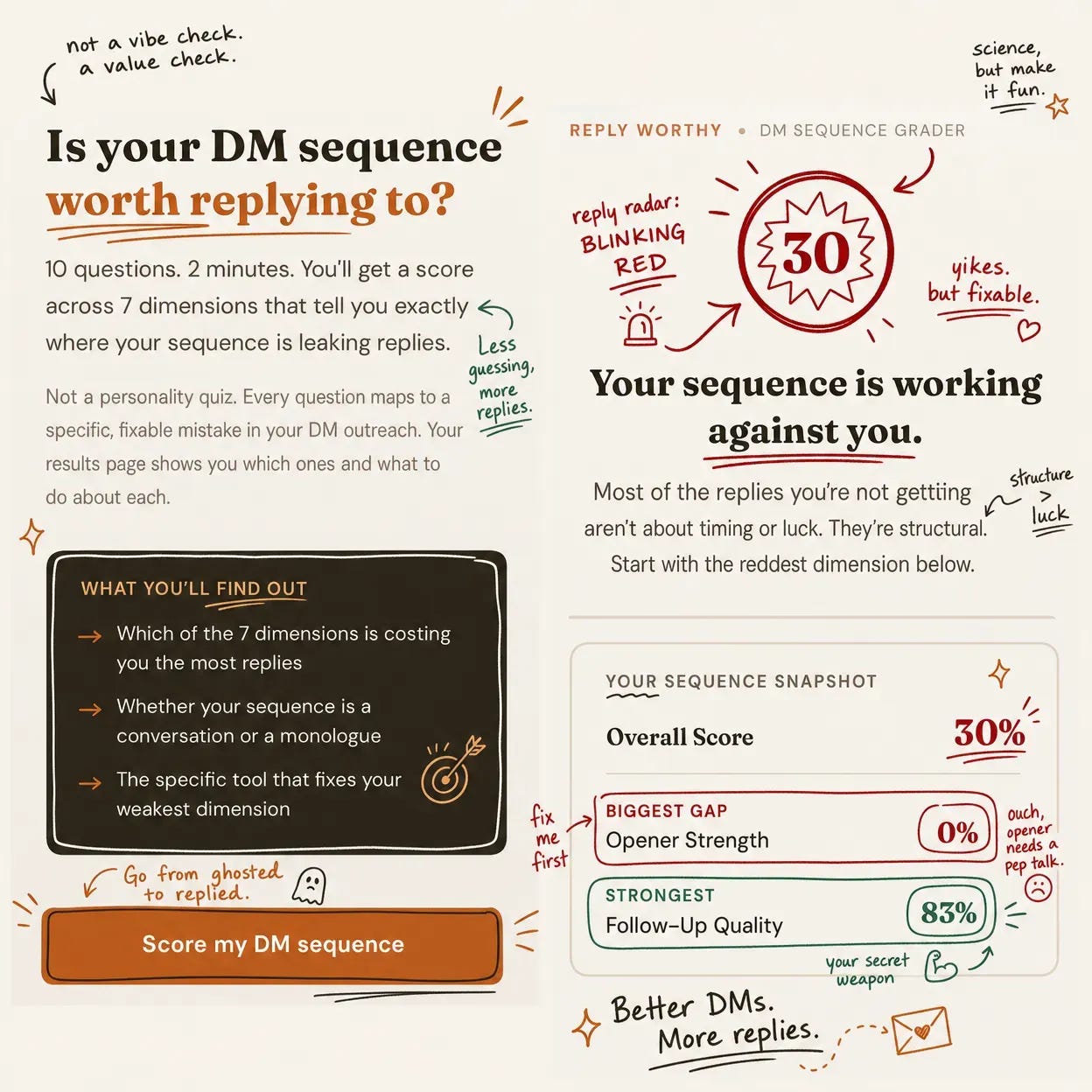
→ Score your DM sequence or last DM conversation for free here
Before & After
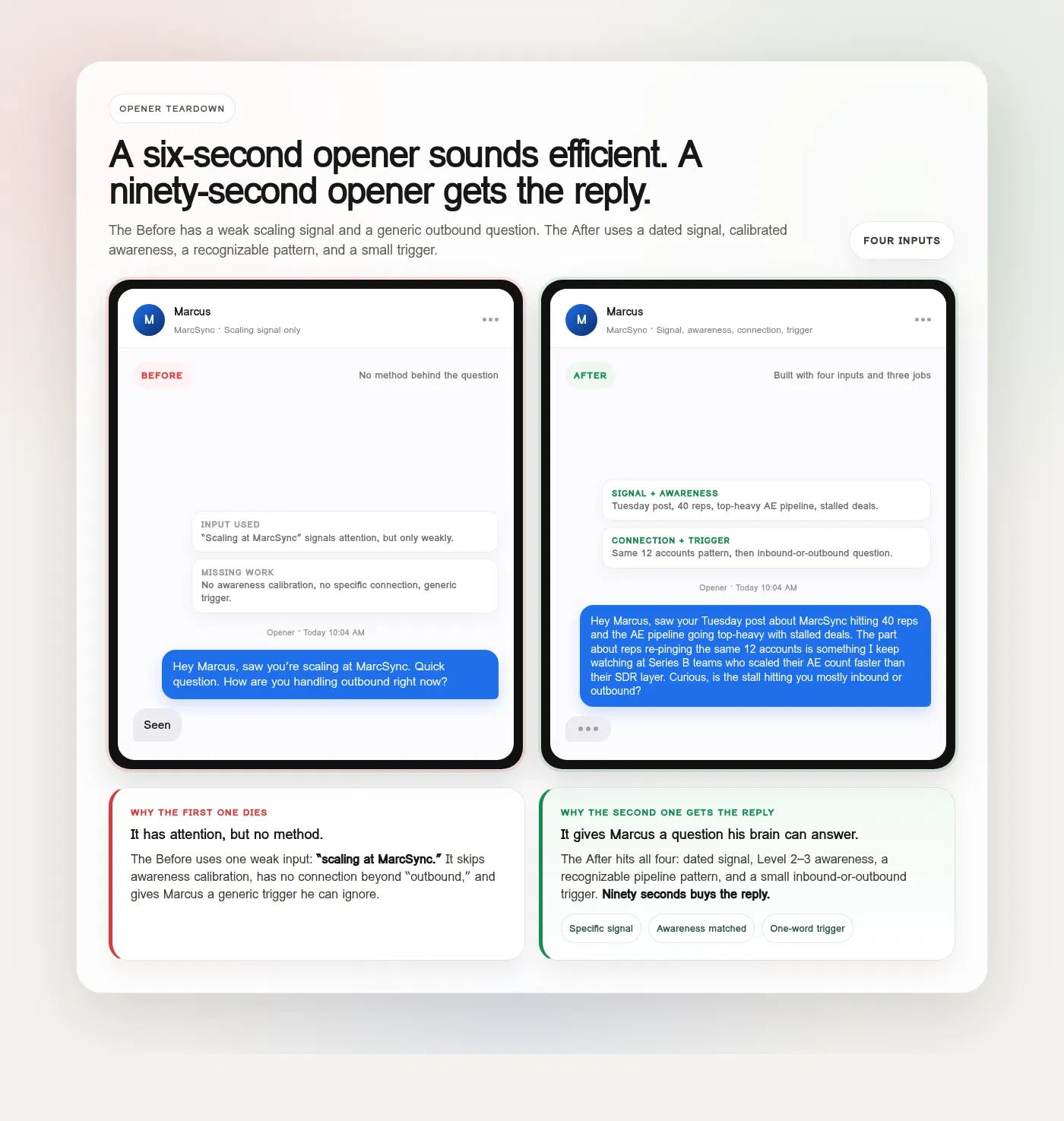
Here’s how to fix it in your own DMs:
1️⃣ Build the input cheat sheet before you build the opener.
Your setter should be able to fill in the four inputs in 90 seconds. Build the template, run it on 5 sample prospects, refine it. A team that can read the inputs in 90 seconds can write the opener in another 90. A team that can’t read the inputs writes generic openers forever.
2️⃣ Run every opener through the three-job score before send.
Acknowledge (0-3), Connect (0-3), Trigger (0-3). Below a 6, don’t send. Rewrite.
3️⃣ Build two openers per prospect, not one.
One calibrated to Level 1-2 (curious peer energy). One calibrated to Level 3-4 (peer who’s already done the work). Your head of growth (or whoever’s over your DMs) picks the right one based on the awareness signal. Two openers. Same sequence after that. Higher reply rate either way.
That’s it.
Here’s what you learned today:
→ Every opener is built from four inputs (signal, awareness, connection, trigger) and assembled in three jobs (Acknowledge, Connect, Trigger).
→ Most teams skip the inputs and reverse-engineer from the trigger, which is why their openers feel forced and get ignored.
→ The fix is building the input cheat sheet first, then assembling the three jobs in order, with the energy calibrated to the prospect’s awareness level.
Start with just one:
Pull up a LinkedIn profile of a real prospect on your list.
Fill in the four inputs in 90 seconds. Set a timer.
If you can’t fill all four, the profile is the wrong target, not the opener.
Move on to the next.
Over 31 days, I’m walking you through:
→ How to build the discovery layer that earns the next message
→ How to expand impact without over-pitching
→ How to write a message that creates the “I hadn’t considered that” moment
→ How to write a Value Drop that earns the call without asking for it
→ How to write a close that works because 6 messages earned it
→ How to build a recovery system calibrated to WHERE in the sequence they went silent
→ The full sequence assembly, every piece, scored against every diagnostic from the series
Today’s mega-prompt doesn’t just give you an opener
It takes your prospect details and your offer, runs the four-input read, and gives you back three opener variants.
Each one scored on Acknowledge, Connect, Trigger, and calibrated to a specific awareness level.
Paid members get:
✔ The Opener Builder System
→ Paste your prospect details and offer, get back 3 calibrated opener variants
→ Each variant scored 0-3 on Acknowledge, Connect, and Trigger before you ever copy it
→ See which awareness level each variant targets so your head of growth can pick the right one
✔ A one-page input cheat sheet your setter can fill in for any prospect in 90 seconds
✔ Two opener templates pre-built for the two awareness levels your ICP lives in
My friend’s kitchen has cabinets again. The first ones she chose were wrong. She replaced it. The second one is the one she’ll have for the next 15 years. That’s how builds work. Run the method.
