



I went to a new primary care doctor last year after a change in my insurance.
Honestly could write a whole article on that process alone… but I digress.
Anywho, the Doc was highly recommended by a friend whose taste in everything else I trust.
I walked in expecting the usual. A nurse who takes vitals while looking at the screen. A doctor who walks in with a clipboard, listens for 8 seconds, and writes the prescription before I finish the sentence.
That’s not what happened.
The doctor walked in. Closed the laptop. Sat down across from me. Not behind the desk. Across.
She said: “Before I write anything, walk me through what’s going on. Take your time. I’m not in a rush.”
I told her the surface thing I came in for. The thing I’d typed into the patient portal three days earlier.
She let me finish. Then she asked another question. Specific. Not the symptom. The pattern around the symptom.
I answered. She asked another question.
20 minutes later I’d told her things I hadn’t planned to tell her. Things I hadn’t connected to the surface thing. The actual issue underneath the issue I came in for.
She wrote one thing in her notes. One.
Then she said: “Here’s what I think we should rule out first. Let’s start there before we treat anything.”
I left that appointment more sure of what was happening in my body than I’d been in the last 4 years of perimenopause.
She didn’t fix anything that day. She didn’t even prescribe anything. She just asked the right questions in the right order.
The fact that this is so unusual that it’s story-worthy is another whole article I could write.
But I watch DM sequences/conversations skip the doctor’s appointment and prescribe straight from the patient portal entry every single week in the funnels I autopsy.
Today, I’m walking you through how to build messages 2 and 3 as a matched pair. The two messages that turn “tell me more” into the conversation that earns the call.
→ Why messages 2 and 3 are the most under-built messages in every sequence I score
→ The two questions that pull the real problem out of the prospect’s head
→ How to write the handoff between them so the conversation builds instead of stalls
Let’s start with the doctor who sat down...
🔍 Build 2: The Discovery Layer
After the opener lands, and we get a response, time to move in to discovery.
Discovery has 2 steps.
1️⃣ Step 1: Surface The Goal.
Essentially, getting them to articulate what they’re trying to achieve in their own words, not yours.
✅ The question should be formed like this: “On the [topic from their reply], what does a great quarter look like for you specifically? Like, what would you want to be true about [topic] 90 days from now?”
❌ Not: “What are your goals?”
We gotta be specific to be dynamic.
We want the Surface The Goal question to be built so the prospect has to think think a little before they answer, but we should know our ICP well enough that they don’t have to think very long.
It should be something that when asked, the answer is already on the tip of their tongue because it’s something they’re dealing with everyday.
And once they say it out loud, the goal is theirs. Anything you offer them after that connects to a goal they named, not one you assumed.
2️⃣ Step 2: Uncover The Challenge.
Get them to name the specific obstacle, not the symptom.
✅ The question that works: “Got it. When you think about getting from where you are now to [their stated goal], what’s the part that keeps not happening on its own?”
❌ Not: “What’s stopping you?”
That gets blame. Or worse, false confidence (”nothing, I just need...”).
The Uncover The Challenge question is built to surface the friction the prospect is already aware of, but hasn’t named to a stranger before.
You’re not telling them what their problem is. You’re asking them to point at it.
The handoff between Step 2 and Step 3 matters as much as the two messages themselves.
If Step 2 lands and the prospect answers, Step 3 has to start with a reference to what they said.
Use some form of: “Got it. The part about [specific phrase they used]...”
That phrase shows you read what they wrote. It earns the next question.
If the handoff is weak, Step 3 feels like an interview, or worse, an interrogation.
If the handoff is sharp, Step 3 feels like a conversation. And the prospect leans in further.
Your first message landed. They replied. Now what?
Most sequences pivot straight to pitching. Your prospect just opened the door. And instead of walking through it like a person, you shoved a brochure through the gap.
🤖 I built a free DM Sequence Grader that scores your sequence (or existing conversations) across 7 dimensions in under 3 minutes.
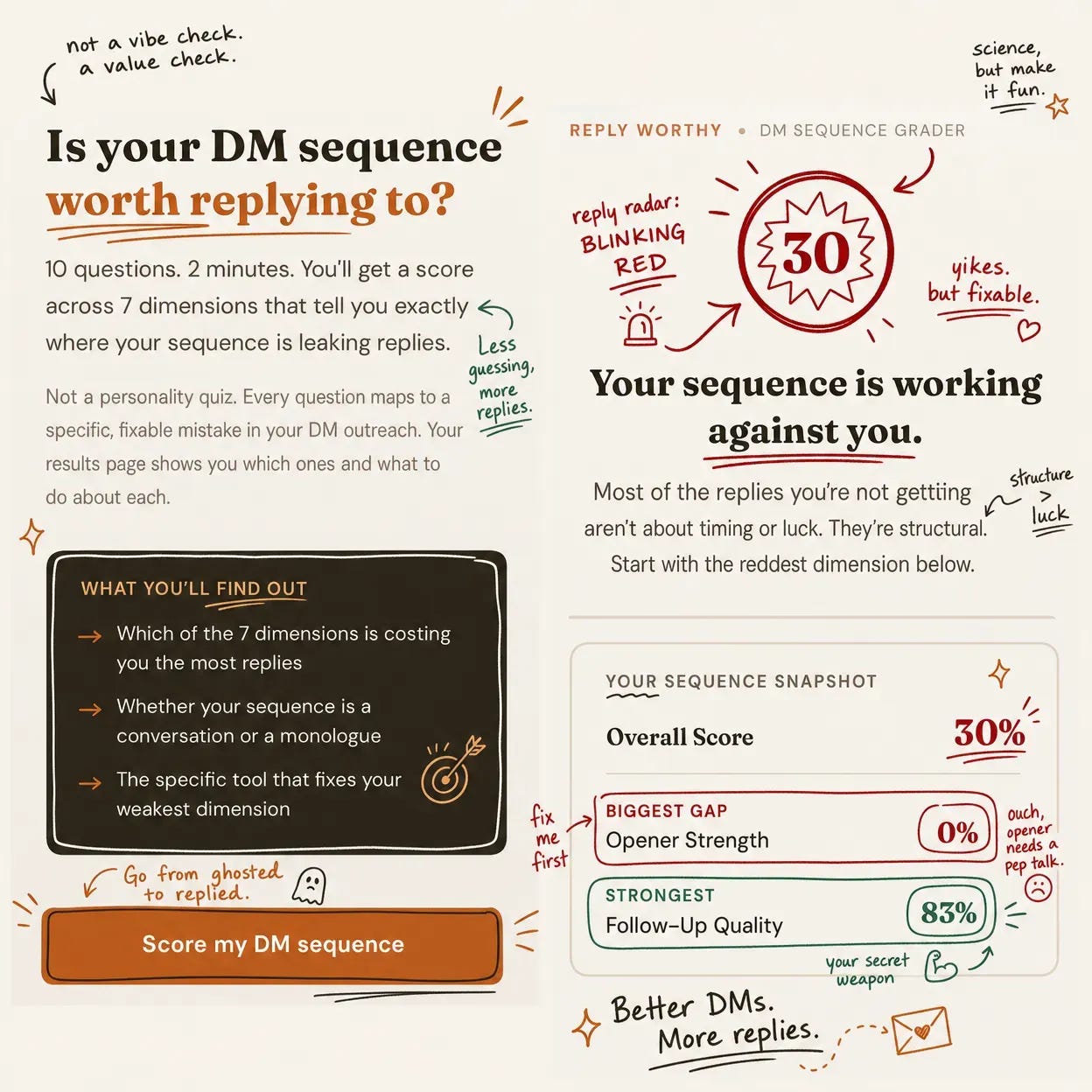
→ Score your DM sequence or last DM conversation for free here
Before & After
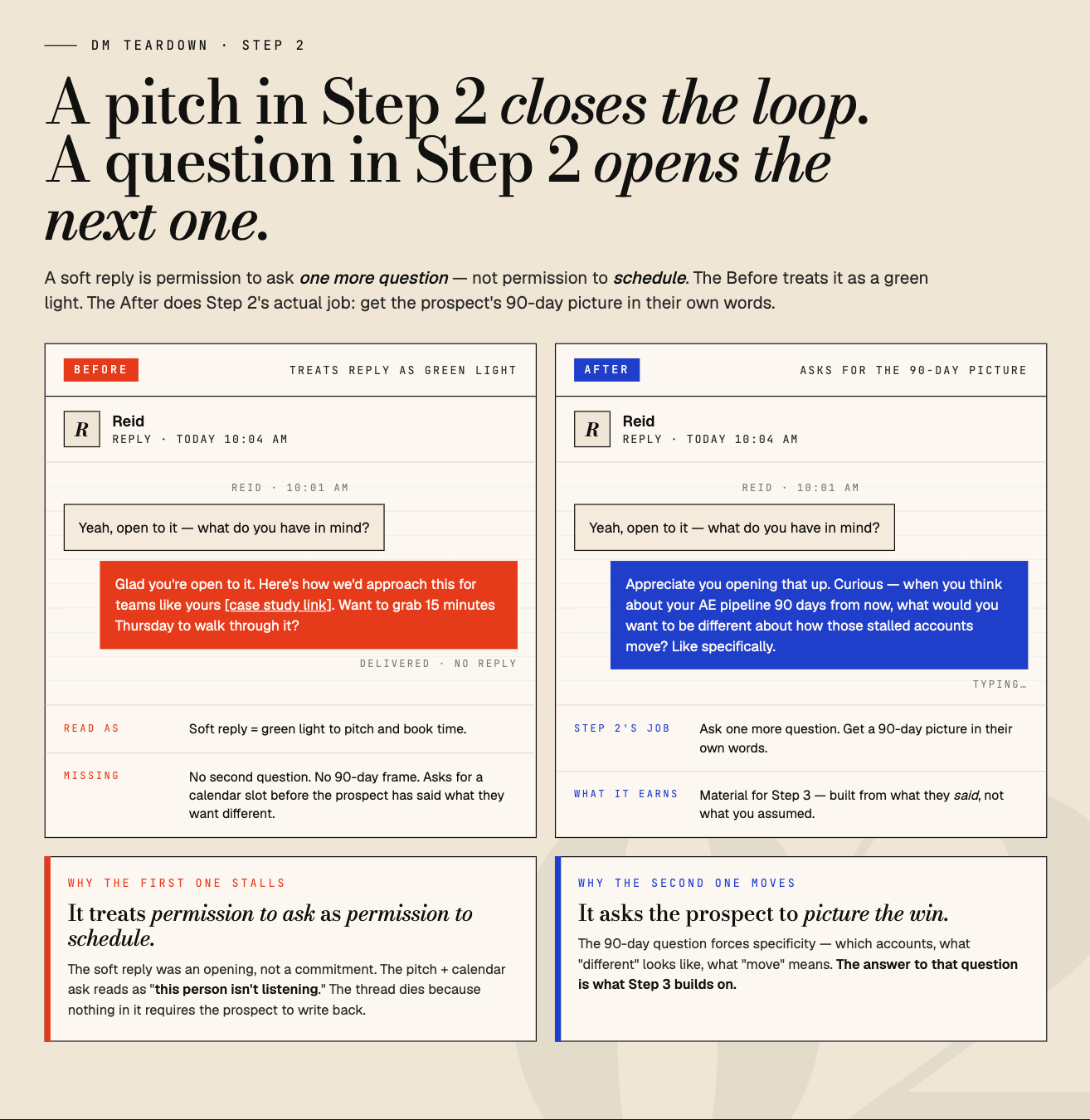
Here’s how to fix it in your own DMs:
1️⃣ Write Step 2 and Step 3 as a matched pair, not as two separate messages.
Your setter shouldn’t be writing message 2 today and message 3 next Tuesday. The two questions are designed together.
The handoff between them is the asset.
Build them at the same time, on the same prospect, with the same context.
2️⃣ Anchor every Step 3 in a phrase from the Step 2 reply.
Your head of growth or VA should be trained to pull one specific phrase from the prospect’s Step 2 answer and use it verbatim in Step 3.
That phrase is the proof you read what they wrote. It’s also the bridge that turns the exchange into a conversation instead of an interview.
3️⃣ Build a Discovery Library of 5 Step 2 / Step 3 pairs per ICP.
Most founders I work with create one Step 2 question… then use it for everyone.
Then one Step 3 question. And use that for everyone.
Same pair for SaaS founders, agency owners, and consultants.
The library should be ICP-specific.
Build five pairs. Train the setter. Stop running one-size-fits-all discovery.
That’s it.
Here’s what you learned today:
→ Messages 2 and 3 are a matched pair. Step 2 surfaces the goal. Step 3 uncovers the challenge. Together they build the discovery layer.
→ Most sequences skip the discovery layer entirely and pivot to pitching as soon as the prospect softens. The prospect bails because they were never asked.
→ The fix is writing both messages at the same time, anchoring Step 3 in a phrase from the Step 2 reply, and building a Discovery Library per ICP.
Start with just one:
Pull up your last sequence where a prospect replied to message 1 and didn’t reply to message 2.
Read message 2. Ask yourself: “Was this a question that surfaced their goal, or a pitch dressed as a question?”
If it was a pitch, rewrite it as a Step 2 question.
Over 31 days, I’m walking you through:
→ How to expand impact without over-pitching
→ How to write a message that creates the “I hadn’t considered that” moment
→ How to write a Value Drop that earns the call without asking for it
→ How to write a close that works because 6 messages earned it
→ How to build a recovery system calibrated to WHERE in the sequence they went silent
→ The full sequence assembly, every piece, scored against every diagnostic from the series
→ The May Vault: every diagnostic, every builder, every assembly tool in one place
Today’s mega-prompt doesn’t just give you Step 2 and 3
It builds them as a matched pair, calibrated to your offer and the prospect’s reply, with the handoff phrase pre-anchored.
Paid members get:
✔ The Discovery Message Builder
→ Paste the prospect’s reply to message 1, get back a Step 2 and Step 3 matched pair
→ Each pair anchored in a phrase from the prospect’s actual words
→ Pre-checked for premature pitching, generic question energy, and interview-feel
✔ A Discovery Library template your team can fill in with 5 pairs per ICP
✔ A handoff phrase generator that pulls the right line from any Step 2 reply
The doctor sat down before she prescribed. Your team can do the same thing in two messages, if they build the pair instead of writing two more pitches.
