


My uncle moved back to Chicago from Louisiana one year. Grabbed damn near the first house he could find. Just wanted to be settled.
Two months in, he noticed a drip in the back bedroom. A small one.
Didn’t do much about it. Just started catching it in a bucket during heavy rain.
Figured it was one shingle. Kept saying “I need to get somebody out here about that.”
Finally called somebody. Old head from the neighborhood, been doing roofs since the 80s. Showed up in a work truck with his son.
No lengthy sales pitch. Just asked a few questions and climbed up on the roof.
Came back down 15 minutes later. Asked my uncle to come up with him.
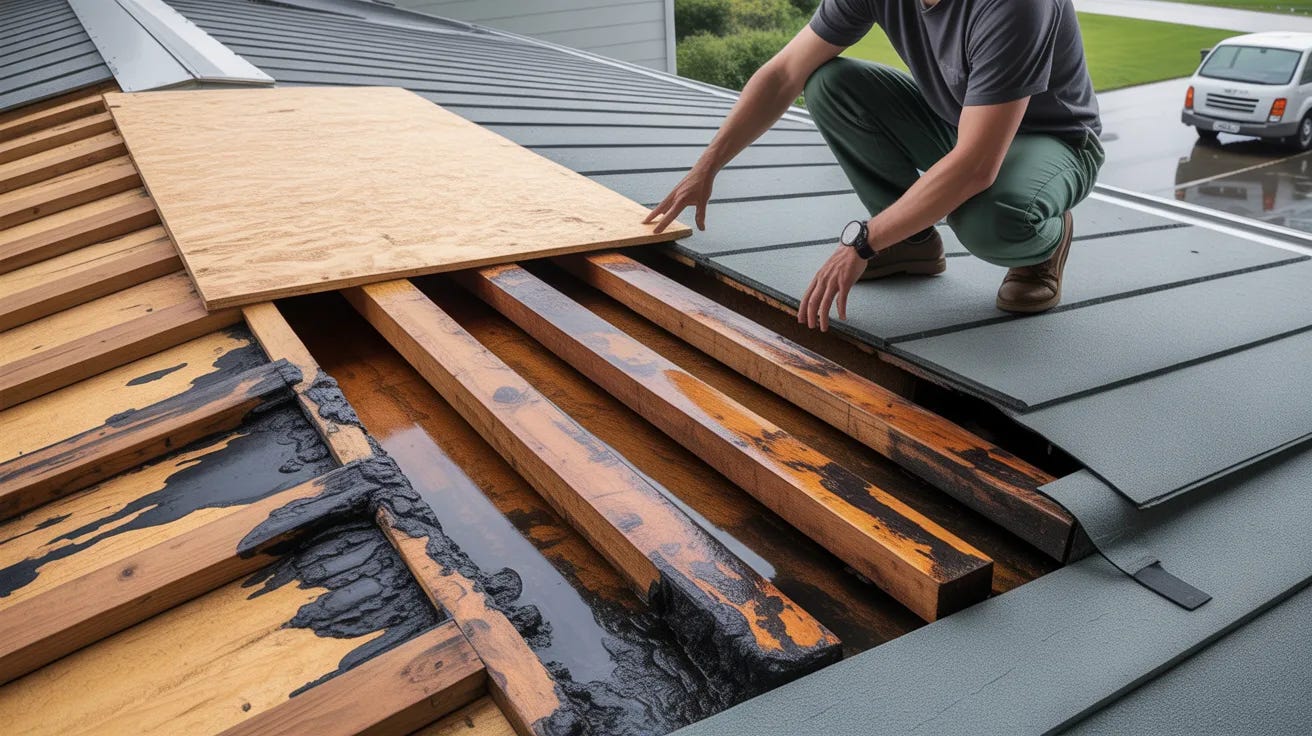
The roofer had pulled back a piece of plywood near the leak. Underneath was a 3-foot section of rotted decking. Soaked through. Black at the edges.
The leak had been running into the attic since before he moved in. The shingle was just where it finally showed up inside.
“One shingle would have been a $400 repair,” the roofer said. “This is a $4,200 repair. The rot is the actual problem. The shingle was just where the rot announced itself.”
My uncle paid the $4,200.
He told me later that if the roofer had just replaced the shingle, the leak would have stopped for about 3 weeks. Then the rot would have spread, the ceiling would have collapsed, and he’d have been looking at $18K instead of $4,200.
My uncle didn’t say yes to the $4,200 because he had a spare $4200 laying around. He said yes because the roofer pulled back the plywood.
When I’m autopsying DM funnels, there’s one thing that sticks out a lot in the conversations. The setters almost never pull back the plywood.
Today, I’m walking you through how to build message 4. The Impact Expander. The message that shows the prospect how big the problem actually is before you offer to fix it.
→ Why “we can help with that” kills more deals than “your pricing’s too high” ever will
→ The three angles you can use to expand impact without sounding like a fear-monger
→ How to write a message that makes the prospect commit to the call before you ask for it
Let’s start with the rot under the shingle...
💥 Build 3: The Impact Expander
After message 2 surfaces the goal and message 3 uncovers the challenge, the prospect has named the surface problem. The shingle.
They haven’t seen the rot yet.
If you skip from surface problem to “let’s hop on a call,” they say “let me think about it.” Because right now, in their head, it’s a $400 problem.
A $400 problem isn’t worth a call. They’ll fix it themselves on Saturday.
The Impact Expander is the message that pulls back the plywood.
Three angles you can use to expand impact. Pick the one that matches what the prospect just told you.
1️⃣ ANGLE 1: The compounding angle.
“Most teams I see in your situation don’t realize that [surface problem] usually means [downstream consequence] inside 6 to 12 months.”
You’re showing them where this is going if they don’t address it. Not as a scare tactic.
As a pattern from teams who looked exactly like them last year.
2️⃣ ANGLE 2: The hidden cost angle.
“The thing that doesn’t usually get measured is [the second-order cost]. For most teams in your shoes, that’s running about [specific number] before anyone notices.”
You’re naming a cost they haven’t put on a spreadsheet yet.
3️⃣ ANGLE 3: The opportunity-cost angle.
“While you’re working on [surface problem], the teams who get past this typically free up [specific outcome] inside [specific time]. The [shingle] is the surface. The [rot] is what’s keeping the rest of your team from [outcome].”
Whichever angle you pick, the structure is the same.
You name what they said. You name what’s underneath. Then you name what happens if it stays unaddressed, stopping just short of pitching.
The Impact Expander IS NOT a pitch. It’s an X-ray.
The prospect prescribes the call themselves after they see the rot.
Most setters never expand the impact.
They go from “we can help with that” straight to “want to grab 15 minutes Thursday?”
The problem is, the prospect, in their head, is still looking at a $400 problem, not a $4200 one.
Your prospect told you the problem.
Your team said “great, let’s hop on a call.”
And the prospect went quiet. Because you treated a symptom like a diagnosis.
🤖 I built a free DM Sequence Grader that scores your sequence (or existing conversations) across 7 dimensions in under 3 minutes.

→ Score your DM sequence or last DM conversation for free here
Stop prescribing before the X-ray.
Before & After
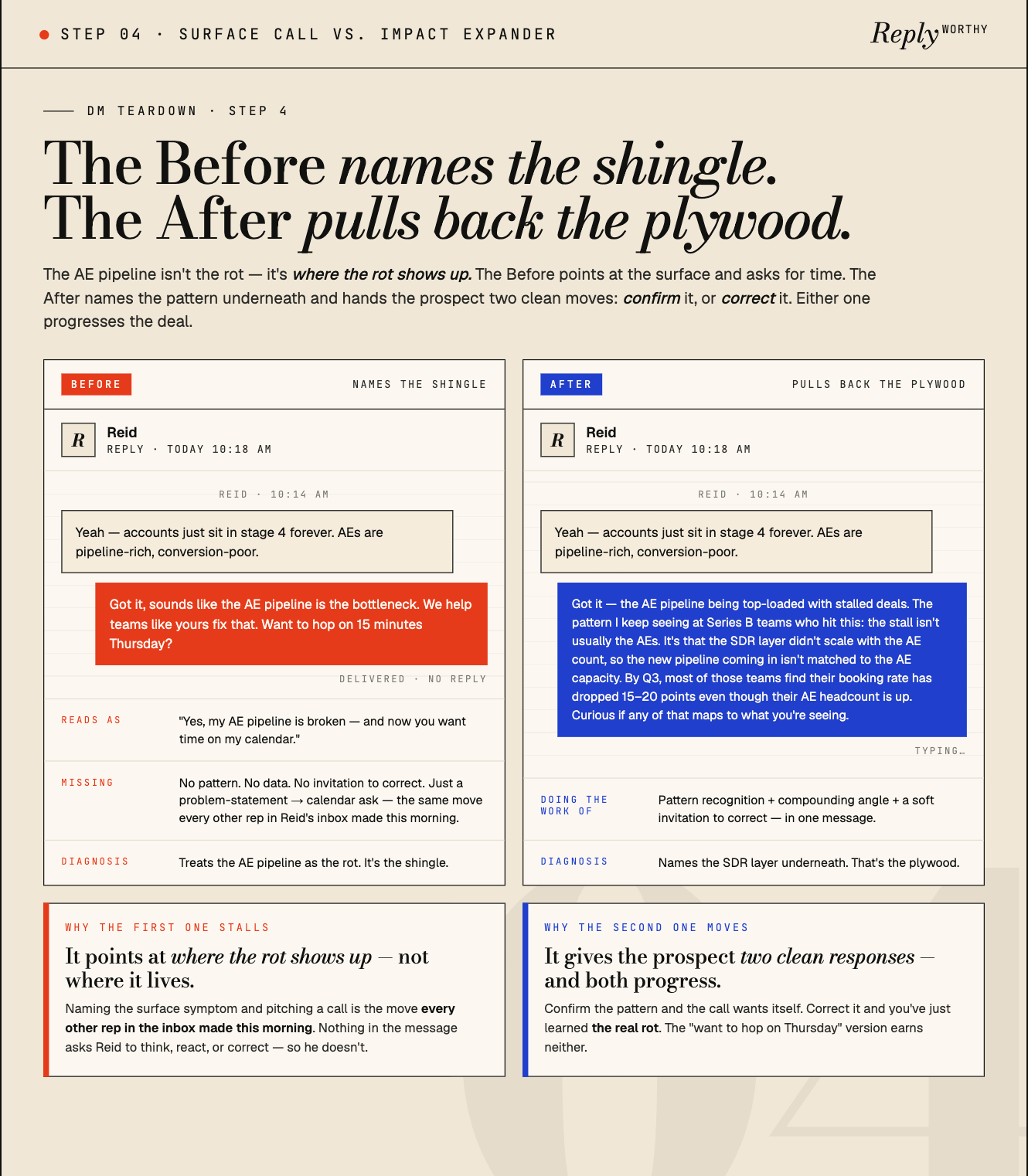
Here’s how to fix it in your own DMs:
1️⃣ Pick the angle before you write the message.
Compounding, hidden cost, or opportunity cost. Each angle needs different evidence.
Your setter or head of growth or VA should know which angle they’re using before they start typing. Pick first, write second.
2️⃣ Name a specific number or pattern, not a vague consequence.
“Most teams find their booking rate drops 15-20 points” lands. “This can get worse over time” doesn’t.
The Impact Expander is built on specifics. If you don’t have the specific number or outcome, your VA shouldn’t be sending the message.
Get the number. Then send.
3️⃣ End with a question, not a pitch.
The Impact Expander ends with “curious if any of that maps to what you’re seeing,” not “want to hop on Thursday.”
The prospect, having just seen the rot, will often ask for the call themselves. Let them.
That’s it.
Here’s what you learned today:
→ The Impact Expander is the message that pulls back the plywood so the prospect sees the rot, not just the shingle.
→ Most sequences skip the Impact Expander entirely and pivot from surface problem to call ask. The prospect, still looking at a $400 problem in their head, ghosts.
→ The fix is picking one of three angles (compounding, hidden cost, opportunity cost), naming specific numbers or patterns, and ending with a question that lets the prospect ask for the call.
Start with just one:
Pull up your last sequence where a prospect replied to your first few message with specifics about their situation, and then went quiet.
Read the message right before they ghosted and ask yourself:
“Did this expand the impact or simply pitch the call?”
If it pitched, rewrite it as an Impact Expander with one of the three angles. Restart the conversation with that.
Over 31 days, I’m walking you through:
→ How to write a message that creates the “I hadn’t considered that” moment
→ How to write a Value Drop that earns the call without asking for it
→ How to write a close that works because 6 messages earned it
→ How to build a recovery system calibrated to WHERE in the sequence they went silent
→ The full sequence assembly, every piece, scored against every diagnostic from the series
→ The May Vault: every diagnostic, every builder, every assembly tool in one place
→ Built to Reply: the 30-day rebuild of every system that surrounds the sequence
Today is Day 25.
Today’s mega-prompt doesn’t just write you an Impact Expander.
It takes the prospect’s stated challenge, picks the right angle (compounding, hidden cost, or opportunity cost) based on the ICP, and generates the message with calibrated specifics.
Paid members get:
✔ The Impact Expander Builder
→ Paste the prospect’s challenge and ICP, get back the recommended angle and a paste-ready Impact Expander
→ Each output includes the specific number or pattern to anchor the message
→ Pre-checked for fear-mongering, vague consequence language, and premature pitching
✔ A three-angle decision tree your setter can run in 60 seconds before writing
✔ A specifics library: 10 verified industry patterns to anchor Impact Expanders for the most common ICPs
The roofer showed my uncle the rot, so my uncle wrote the check. Your sequence can do the same thing, if it’s built to show the prospect what’s actually underneath.
