



I had a noise in my Camry a few years ago. A clunking sound. Not all the time. But enough.
I took it to the dealership first. Service advisor walked out, took the keys, and was back in 20 minutes.
“Brake pads. We can do it for $620.”
Too rich for my blood at the time. Took the car to a guy a friend recommended.
Smaller shop. Roof rack on his truck. One of them old ass bluetooth sets behind his ear.
He sat in the driver’s seat with the door open, then asked me to tell him about the noise.
I said ‘it clunks’.
He said: “Okay, walk me through it. When does it happen?”
I told him.
“At what speed?”
I told him.
“On turns or straight roads?”
Turns.
“Left turns or right turns?”
Left turns.
“At a stop or rolling?”
Rolling.
He nodded. Drove the car around the block. Lifted the car. Spent four minutes underneath.
“Sway bar end link,” he said. “Not your brakes. The dealership tried to sell you brake pads because that’s what they sell. Your brakes are fine. The bushing on your left sway bar end link is shot. $90. I can do it Tuesday.”
I paid the $90 on Tuesday. The clunk stopped.
The dealership was selling brake pads. Just like your setter is selling check-ins.
Today, I’m walking you through how to build the Recovery System. Not one recovery message. A system. So that every type of silence gets the right next move.
→ Why “just checking in” is the brake-pad sale of DM outreach
→ The four silence points your sequence will hit and what each one is telling you
→ How to build a recovery library your setter can deploy without thinking
Let’s start with the mechanic who asked the right questions...
🔄 Build 7: The Recovery System
Silence in the DM isn’t a problem. Silence is a signal.
The Recovery System is the set of pre-built recovery messages your team deploys based on where in the sequence the prospect went quiet.
Four recovery moves. Build all four. Train the team. Stop guessing.
1️⃣ POINT 1: They never opened message 1.
The recovery isn’t “circling back.” There’s no thread to circle back to.
The recovery is a different opener entirely, sent fresh, with a different angle and a different signal.
2️⃣ POINT 2: They opened message 1 and 2 but didn’t reply to either.
That's a stall, not a no. Don't call out the silence. It just puts them on defense and makes the next reply harder, not easier.
Show up like nothing's wrong, drop a sharper angle on the same problem, and attach no ask.
Use the line: "Been thinking about the [problem] thing. Something that might actually move it: [angle]."
3️⃣ POINT 3: They replied to messages 1 or 2, then went quiet between 3 and 5.
This is the warm fade. They engaged. Something shifted.
Name what you suspect specifically and give them a low-cost way to either correct you or close the loop.
4️⃣ POINT 4: They engaged through the Value Drop or Insight Bridge, then went quiet.
This is the polite stall. Something inside their world blocked the next move.
The recovery is a re-opener with no ask. Reference something outside the thread that reminded you of them. Earn the re-engagement without proposing.
Each template gets refined for your ICP.
Each recovery move gets a specific paste-ready template.
Each refinement gets logged so the team can see what’s working over time.
The Recovery System isn’t a script. It’s a decision tree your VA or setter or head of growth can run in 60 seconds:
1️⃣ Where did they go quiet?
2️⃣ What does the silence type tell us?
3️⃣ Which recovery template fits?
Customize one detail, send.
Most teams send the same “just checking in” regardless of where the prospect ghosted. It’s the brake-pad sale of DM outreach.
Before & After
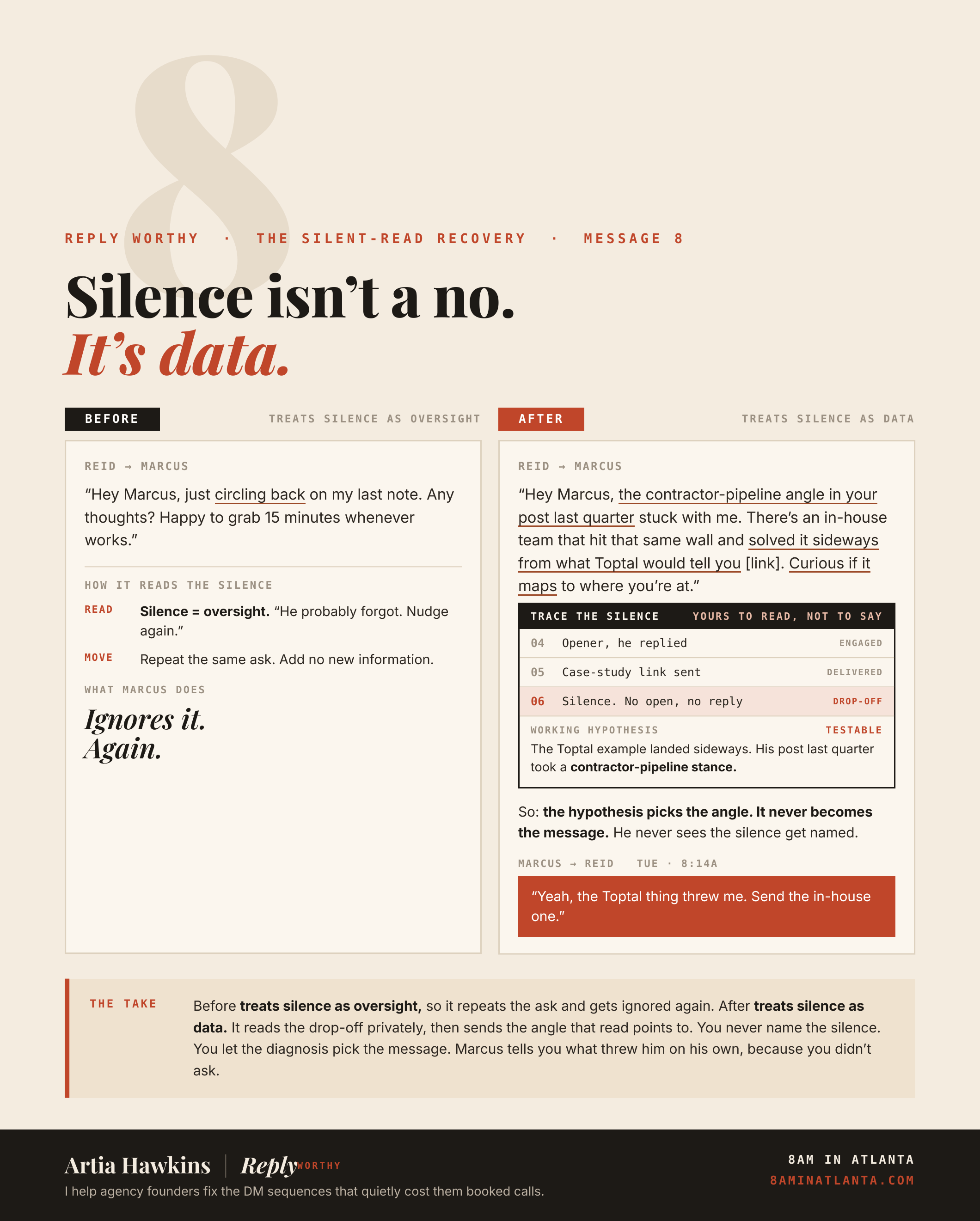
Here’s how to fix it in your own DMs:
1️⃣ Build all four recovery templates before you deploy any of them.
Your setter or head of growth should not be writing recovery messages on the fly. Build the four templates (Point 1, 2, 3, 4) once. Refine them for your ICP. Save them. Deploy from the library. The recovery decision should take 60 seconds, not 60 minutes.
2️⃣ Tag every silenced thread by silence point inside your CRM.
Your VA should be classifying threads at the moment of silence: Point 1, 2, 3, or 4. The tag becomes part of the thread. The right recovery template gets deployed automatically. Reid’s setter never tagged threads, which is why she kept sending the same recovery to every silence.
3️⃣ Run a recovery report monthly.
What percentage of ghosted threads re-engaged after the calibrated recovery? Break it out by silence point. The data tells you which templates need rewriting and which ICPs need different recovery moves. Without the report, your team is guessing forever.
That’s it.
Here’s what you learned today:
→ Silence is a diagnostic. Four silence points (never opened, opened-no-reply, warm fade, polite stall) each get a different recovery move.
→ Most sequences send the same “just checking in” to every silence. The pipeline shows it.
→ The fix is building all four recovery templates once, tagging silenced threads at the moment of silence, and running a monthly recovery report to refine the templates.
Start with just one:
Pull up the last 5 silenced threads in your DMs
For each one, classify the silence point: 1, 2, 3, or 4.
Pick one. Write the calibrated recovery template for that silence point today.
Use it on the next prospect who goes quiet at the same point.
Over 31 days, I’m walking you through:
→ The full sequence assembly, every piece, scored against every diagnostic from the series
→ The May Vault: every diagnostic, every builder, every assembly tool in one place
→ Built to Reply: the 30-day rebuild of every system that surrounds the sequence
→ The first 7 days of June: the prospect targeting system that determines who ever sees your sequence
→ The first 14 days of June: building the conversation architecture for a new prospect from scratch
→ The second half of June: scaling the system from 10 prospects to 100 without losing reply quality
Today’s mega-prompt doesn’t just give you a recovery message.
It takes any silenced thread and maps the silence point to the right recovery template, then customizes it with one specific detail from the thread.
Paid members get:
✔ The Recovery System Builder
→ Paste any silenced thread, get back the silence point classification and a paste-ready calibrated recovery
→ Each output is matched to one of the four silence types
→ Pre-checked for “just checking in” energy, signal blindness, and over-asking
✔ A four-template recovery library customized for the most common ICPs
✔ A silence-point tagging cheat sheet your VA can run inside your CRM in 60 seconds per thread
