



My cousin Jay bought a high-rise condo about five years ago. 14th floor. Kitchen window overlooking Wrigley Field.
He decided to furnish it himself. No designer. Just him and his phone.
For three months he ordered things. A walnut credenza from one site. A linen sectional from another. A leather chair from a vintage shop.
Brass lamps. A rug that took six weeks to ship from overseas. Coffee table from a guy on Instagram.
Every piece was beautiful in the photo.
Moving day came. Everything arrived the same week. Jay called me on a Sunday afternoon. “Tia. The pieces don’t work together.”
He sent me pics.
The sectional was 4 inches too long for the wall. The credenza was the wrong wood for the floor. The rug was 18 inches too small for the seating arrangement. The lamps were a different brass than the coffee table legs.
Every piece was good. Just not together.
Jay said: “I took my time. I don’t understand.”
I told him: “You picked them one at a time, instead of figuring out if they worked together.”
Same thing happens when most people put together their DM funnel.
They build the opener. They build the discovery layer. They build the impact expander. They build the close. Every piece, on its own, is good.
Then they assemble. And the sequence fights itself.
Today, I’m walking you through the full sequence assembly. How to test that your 7 messages talk to each other instead of fighting each other.
→ Why “each message is good” doesn’t mean “the sequence works”
→ The 5 connection points that determine whether a sequence is a room or a warehouse
→ How to score the full assembly before it ever ships to a prospect
Let’s start with Jay’s living room...
🧩 Assembly: The Full Sequence
Seven messages assembled don’t automatically make a sequence. Five connection points have to exist.
1️⃣ CONNECTION 1: The opener and the discovery layer.
Does message 2 reference the signal the opener used?
If the opener acknowledged a post about AE pipeline and message 2 asks about general goals, the prospect hears two different writers.
The thread feels like a mail merge that pretended to be personal. The connection breaks.
2️⃣ CONNECTION 2: The discovery layer and the impact expander.
Does message 4 use a specific phrase from the prospect’s reply in message 3?
If your Impact Expander references “the pipeline” generally when the prospect said “top-loaded with stalled deals,” you didn’t listen. The prospect feels that. They go quiet.
3️⃣ CONNECTION 3: The impact expander and the insight bridge.
Does message 5 build on the rot you exposed in message 4, or does it pivot to a different reframe entirely?
If message 4 showed the prospect the SDR layer problem and message 5 reframes around marketing-sales alignment, you confused them.
The thread loses its through-line.
4️⃣ CONNECTION 4: The insight bridge and the value drop.
Does message 6 deliver value on the exact reframe message 5 introduced?
If message 5 named the AE-to-SDR ratio as the hidden variable and message 6 hands over a generic cold email audit, the value drop feels disconnected.
The peach has to taste like the slice.
5️⃣ CONNECTION 5: The value drop and the close.
Does message 7 reference what the prospect did or didn’t do with message 6?
A signal-blind close after a strong Value Drop is a David moment. You proposed to someone who wanted to keep dating.
All 5 connections have to hold. Any one of them broken, the sequence loses its through-line.
Most teams assemble by counting messages. “We have 7. Let’s send.” The count isn’t the assembly. The connections are.
Usually, founders run their sequence end-to-end exactly once, on themselves, in their own head, before deployment.
They should be running it on a real prospect’s profile, with a real reply at every step, to see whether each message actually talks to the message before it.
Before & After
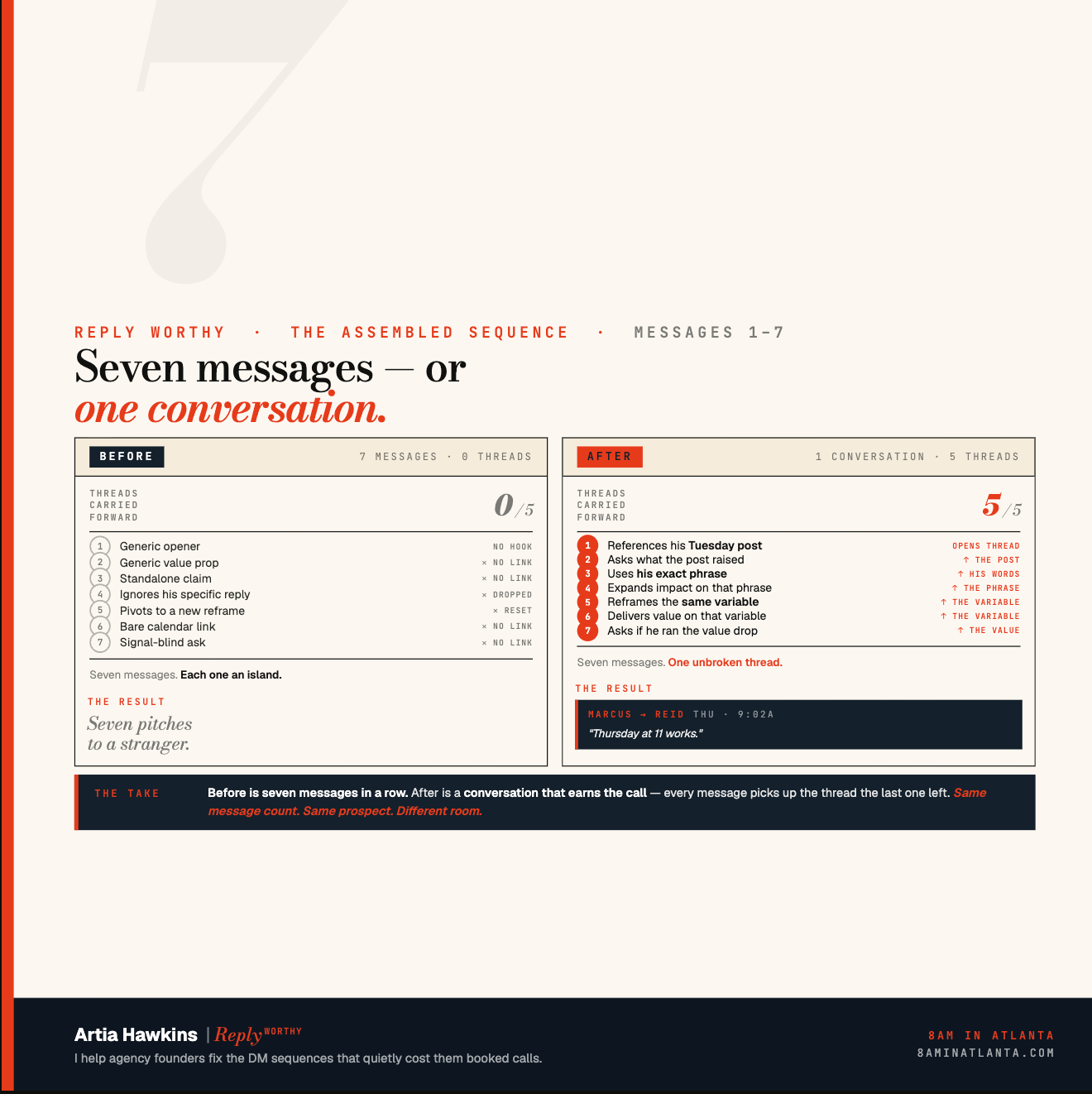
Here’s how to fix it in your own DMs:
1️⃣ Run the 5-connection check on every sequence before deployment.
Your head of growth or you should be running the check on every new sequence variant. Connection 1, 2, 3, 4, 5. Each one passes or fails. If any one fails, the sequence isn’t ready. The check takes 10 minutes. The repair takes 30. Both are cheaper than a quarter of low reply rates.
2️⃣ Build sequences as one document, not seven.
Most write each message in a separate doc, on a separate day, with separate context. That’s why the connections break. Build the full 7 in one document, in one sitting, on one specific prospect. The connections happen naturally when the context is shared across the build.
3️⃣ Run every new sequence on a real prospect profile, all the way through, before scaling.
Pick one prospect. Write the opener for them specifically. Imagine their reply. Write message 2 to that imagined reply. Continue all the way to message 7. If the sequence falls apart anywhere, you found the broken connection before you spent a quarter sending it to 200 people.
That’s it.
Here’s what you learned today:
→ A 7-message sequence is a room, not a stack. Five connections between messages determine whether the room works or fights itself.
→ Most teams build messages separately and assemble by counting. The connections never get checked. The pipeline reflects it.
→ The fix is running the 5-connection check on every sequence, building all 7 messages in one document, and testing the full assembly on one real prospect before scaling.
Start with just one:
Pull up your most-sent sequence.
Run the 5-connection check. Mark each connection: Pass, Weak, or Broken.
If you find even one Broken, that’s the message that needs the most rewriting, regardless of how good it reads on its own.
Today’s mega-prompt isn’t a single diagnostic.
It’s every diagnostic from the May series, run in sequence, on your full assembled 7-message sequence. Spectrum mismatch. Engagement audit. Give-to-take ratio. Silent objection map. Step coverage. Context Gap. All of it. One assembled report. One actionable scorecard for the full room.
Paid members get:
✔ The Full Sequence Assembly Scorecard ($97)
→ Paste your complete 7-message sequence, get every diagnostic from the series run on it
→ The 5-connection check, the dimension scores, the missing-step map, the silent objection forecast
→ A prioritized rewrite list: which 2 messages need the most work and what to change in each
✔ The 5-connection cheat sheet your head of growth runs on every new sequence variant
✔ Three assembled sample sequences (SaaS founder, agency owner, consultant) showing all 5 connections holding
Jay’s room came together. He moved one piece. Replaced two. Found the rug worked when he turned it 90 degrees. The pieces hadn’t changed. The room did. Run the check on your sequence and find the move that turns the warehouse into a room.
