



About 10 years ago I was still in financial services. A referral sent me to a man who owned a chain of coffee shops across the south side of Atlanta. He needed key man insurance on three employees... his head roasters.
I met him on the patio of one of his locations. Late afternoon. The energy of the shop was incredible.
If you’ve ever met someone who’s started a church, you know that’s not what they say. They say they “planted” a church, in the community.
That’s how this owner talked about his coffee shops.
He didn’t say he opened four locations. He said he planted four places where people in the neighborhood could sit and fellowship with each other.
Each shop roasted in-house. Not in a warehouse somewhere. In the back, behind the counter, where you could hear the drum turning and smell the batch before it hit the hopper.
While we were sitting on the patio going over the policy, a shipment of green beans showed up on a pallet. He stopped mid-sentence, held up one finger, walked to the back, and came out 10 minutes later with a handful of beans.
He told me every shipment gets three checks before it goes near the drum.
Moisture. Density. Defect count.
Moisture he measured with a probe. Green coffee should sit between 10 and 12%. Above 12 and the beans mold in storage. Below 10 and they roast too fast, taste hollow, and the regulars notice by Thursday.
Density he checked by dropping a handful into water. High-altitude beans sink fast. Low-altitude beans float or sink slow. The sinkers produce the complex flavors his customers were paying $18 a bag for. The floaters taste flat no matter how you roast them.
Defect count he did by hand. Spread 300 grams across a white tray. Counted the chips, the insect bores, the quakers... underdeveloped beans that roast pale and taste like peanuts. Specialty grade allows 5 defects per 300 grams. He held his shops to 3.
Three checks. Three scores. 15 minutes per shipment.
All three pass, he schedules the roast. Those bags are on the shelf by Friday.
One flag, he pulls a second sample. Sometimes the first scoop was a bad draw. Sometimes it wasn’t.
Two flags, he calls the importer and asks what happened. If the answer is vague, he cancels the next order.
He told me his Ethiopian importer had started sending beans at 13% moisture a few months before we met.
First shipment he flagged it and gave them a pass. Second shipment, same number.
He pulled the contract and found a new source from a co-op whose Wednesday numbers hit clean every time.
His baristas didn’t know the difference until the regulars stopped saying “this tastes different.” That’s how he knew the fix worked.
He sat back down on the patio, picked up the policy paperwork, and said something I remembered as I was thinking of the story I wanted to include with this newsletter:
“I don’t train my baristas to pull better shots out of bad beans. I catch the bad beans before they ever touch the grinder.”
I was there to write an insurance policy. I left with something I’ve used multiple ways in every business I’ve touched since.
Most founders do the opposite of this in their DM funnels.
Reply rate drops. Founder calls a meeting. Everyone audits the opening DM.
They rewrite the personalization line. Test new hooks. Split-test the CTAs.
Reply rate stays flat for another quarter.
What they didn’t audit: the LIST.
The supplier. The Sales Nav saved search that’s been pulling the same type of leads for 8 months that are now highly unqualified for their offer, based on the scoring matrix you built yesterday.
The opening DM isn’t the bottleneck. The bottleneck is who they’re sending that DM to in the first place.
You built the DM ICP on Day 1. You built the 4-Minute Research Protocol on Day 2. You built the Scoring Matrix on Day 3.
Today, I’m walking you through:
→ The 4-point targeting audit you run every Monday on your active prospect sources
→ The specific Sales Nav filter adjustments that move 80% of your pulls from 0-3 territory to 4-9 territory
→ The “supplier renegotiation” rule that decides when a saved search gets adjusted, paused, or killed
Let’s start with bad coffee beans…
🏗️ Today’s Build | The Targeting Audit
How to prevent bad coffee beans from being roasted?
Every Monday, your setter (or you) pulls 20 random prospects from your current active sources and scores them against the rubric you built on Day 3.
Then you check the source against 4 specific tests.
1️⃣ THE FRESHNESS TEST
When was the last time this saved search produced a 7-9 prospect who replied within 7 days?
If the answer is “this month” → fresh. Pass.
If the answer is “last quarter” → stale. Adjust.
If the answer is “I don’t remember” → dead. Kill.
✅ Track this in the scoring sheet from Day 3. Add a column for “Source” so you can attribute every prospect back to the saved search or list source that produced them. Then sort by source + reply rate at the end of every week.
❌ Don’t keep running a Sales Nav saved search “because we built it 6 months ago.” Sources decay. The market moves. A saved search from October is not the same population as it was when you built it.
2️⃣ THE MATCH RATE TEST
Pull 20 random prospects from the source. Score all 20 using the Day 3 matrix. What percent are in the 4-9 zone?
60%+ in 4-9 zone → source is healthy
30-59% → source needs filter adjustment
Under 30% → source is broken, kill or rebuild
✅ Look at WHICH dimension is failing. If 80% of prospects score 0 on ICP Fit, your filters are pulling the wrong company size, wrong industry, or wrong role. If 80% score 0 on Awareness Level, your filters aren’t selecting for active posters. If 80% score 0 on Reachability, the source is pulling lurkers and dead profiles.
❌ Don’t average the 20 scores and call that “healthy.” The point is to surface low scorers. If 14 of 20 score 0-3, the source is leaking 70 percent of your morning attention even if the other 6 score 7-9.
3️⃣ THE LANGUAGE TEST
Read the last 3 LinkedIn posts of 10 random prospects from the source. Are they using the internal language you captured in your DM ICP (Day 1, dimension 4)?
If 6+/10 are using the language → your source is finding prospects in the right conversation
If 3-5/10 → partial match, source is broader than your ICP
If 0-2/10 → wrong audience entirely, source needs a rebuild
✅ This is the test most teams skip. The internal language is the strongest leading indicator that a prospect is at L3-4 awareness, because they’re already saying out loud what they’re trying to fix.
❌ Don’t accept “they’re in our target industry” as a pass. Industry-based filters are too broad. The language test is what separates “in the industry” from “in the conversation.”
4️⃣ THE COMPETITOR-INTERSECTION TEST
Pull the prospect list from the source. Cross-reference against your competitor’s customer list (or public testimonials, case studies, integrations directory, etc.).
What percent of your source overlaps with your competitor’s existing customers?
5-20% overlap → healthy. Some shared ground, plenty of greenfield.
0% overlap → suspicious. Probably means you’re targeting a different segment than where the actual buying is happening.
40%+ overlap → you’re hunting in someone else’s already-fed pond. The prospect’s first move on a reply will be to ask why they should switch.
✅ When you find 5-20% overlap, prioritize the OTHER 80-95%. The competitor’s customers are warmer in some ways (they’ve already bought a similar product) but harder in others (you have to displace incumbency, which doubles your sales cycle). The greenfield is where reply rates are highest.
❌ Don’t ignore the overlap percentage. A source with 60% overlap means your competitor’s sales team has already had 6 conversations with everyone you’re about to message. You’ll be the 7th. Reply rates collapse in that scenario.
The output is a decision per source: keep, adjust, pause, or kill.
Most teams have 4-6 active sources (saved searches, lead magnet opt-ins, webinar attendee lists, podcast guest backfeeds, etc.). After the first audit, expect 1-2 to fail outright. That’s the supplier renegotiation moment.
The audit isn’t about the message you’re going to send. The audit is about whether the prospects you’re sending TO actually should be getting a message in the first place.
Don’t just look at the copy. Audit the supplier.
🔨 I’m running a free 7-day challenge
You’ll build a complete DM sequence from scratch, one message per day, scored against every diagnostic from this series.
A Notion workspace with daily build instructions.
A Telegram group for feedback.
The DM Sequence Grader to score every piece.
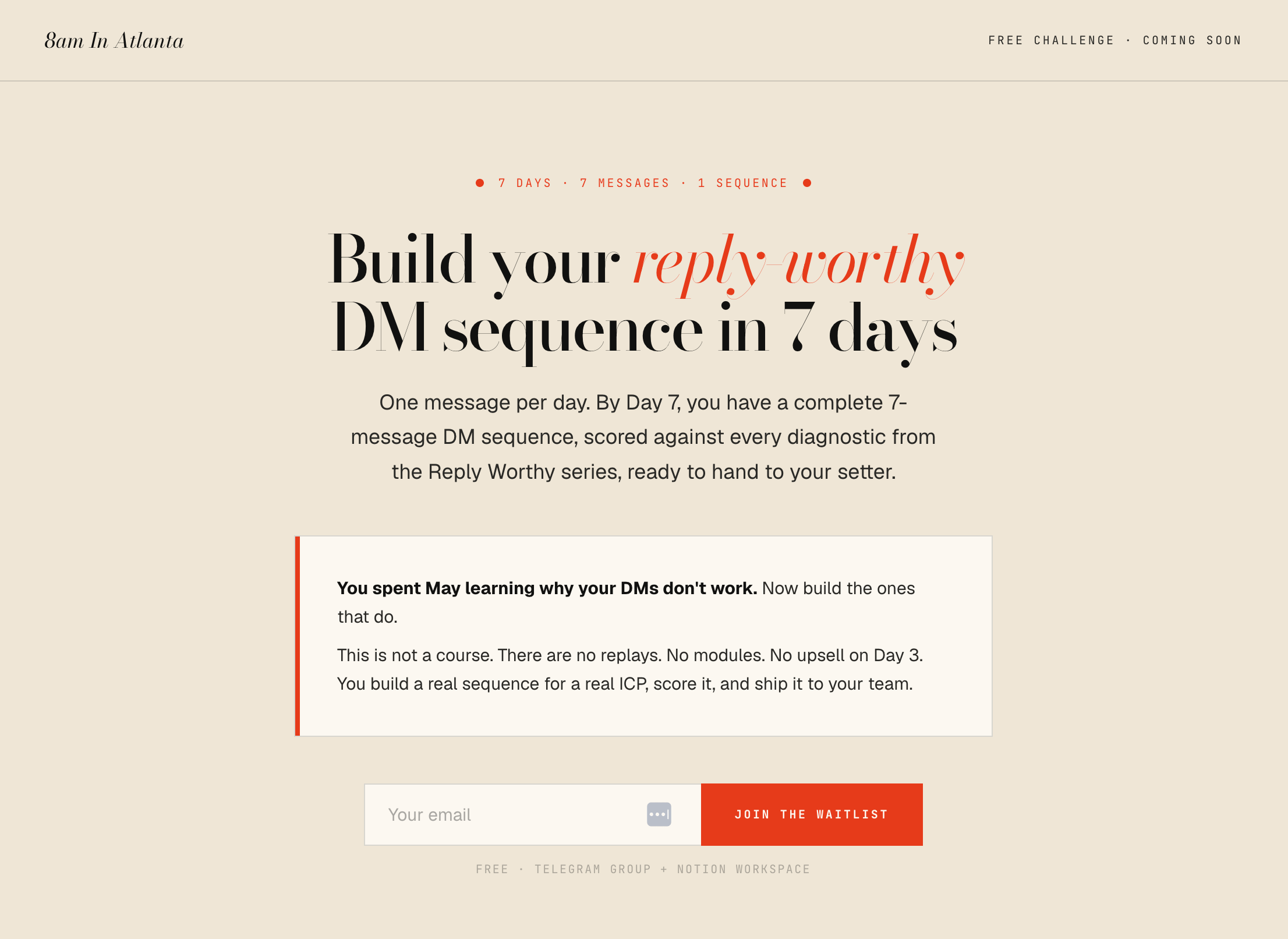
→ Join the 7-Day Build Your Reply-Worthy Sequence Challenge for free here
Here’s how to fix it in your own DMs:
1️⃣ Run a 4-point source audit on every saved search, list, and source you’re actively pulling from this Monday.
Open a doc. List every active source: each Sales Nav saved search by name, every lead magnet opt-in list, every webinar attendee export, every podcast guest list, every newsletter signup form.
For each source, run the 4 tests: Freshness, Match Rate, Language, Competitor-Intersection.
Give every source a final verdict. Keep. Adjust filters. Pause. Kill.
You’ll probably find that 2-3 of your active sources are still pulling, but producing 0-3 prospects at a 60%+ rate. Those sources are quietly burning your setter’s morning. They die today.
2️⃣ Rebuild the filters on the “adjust” sources using the specific failures the audit surfaced.
If the Freshness Test failed
Add a “posted in the last 30 days” qualifier or a “changed jobs in the last 90 days” filter or whatever makes sense for your offer.
If the Match Rate Test failed on ICP Fit
The company size or industry filters are too broad. Tighten to the segment where your last 10 closes actually came from. Use the DM ICP notecard as the rebuild brief.
If the Language Test failed
Add keyword filters that only return profiles where the keywords your DM ICP captures (internal language phrases) appear in headline, About, or recent activity.
If the Competitor-Intersection Test failed
Exclude your competitor’s known customers (Sales Nav lets you upload exclusion lists) -or- equip you or your setters for the inevitable questions incoming.
Re-run the 4-point test on the rebuilt filters.
3️⃣ Add a Source column to your Day 3 scoring sheet so every prospect is attributed to where they came from.
Every row in your scoring sheet now lists the source.
At the end of every week, sort by Source. Look at the average score per source. Look at the reply rate per source. The patterns surface quickly.
Your best source might be a list you forgot about (the 2023 webinar opt-ins still convert because they self-selected for the topic).
Your worst source might be the one you spend the most time building (the broad Sales Nav saved search that pulls everyone in a 5-state radius).
The Source column makes the audit data-driven instead of vibes-driven.
Run it weekly. Adjust monthly.
That’s it.
Here’s what you learned today:
→ Reply rate problems are almost never opener problems. They’re list problems. Stop auditing the message; audit the supplier.
→ The 4-point audit (Freshness, Match Rate, Language, Competitor-Intersection) runs every Monday on every active source and produces a keep/adjust/pause/kill verdict.
→ Add a Source column to your scoring sheet so you can trace every prospect back to where they came from. Cuts and adjustments happen at the source, not at the message.
Start with just one:
Open Sales Nav. Pick your most-used saved search.
Pull 20 random prospects. Score them using the Day 3 matrix. Count how many land in 4-9.
If under 60% of the 20 score in 4-9 territory, your most-used source is leaking your morning. Adjust the filters this week or kill it before next Monday.
Today’s mega-prompt audits your prospect sources for you.
With today’s Targeting Auditor Mega-Prompt:
→ Paste your DM ICP notecard (from Day 1) and up to 5 active sources (Sales Nav saved searches, lead magnet lists, webinar exports, whatever you’re pulling from), and it runs the 4-point Monday morning test on each one: Freshness, Match Rate, Language, Competitor-Intersection.
→ For every “adjust” verdict, you get the specific filter changes to make in Sales Nav or wherever the source lives.
→ For every “kill” verdict, you get 3 alternative source types to test in the next 30 days.
→ Ends with an Overall Portfolio Read that tells you which sources are doing the work and which are quietly burning your setter’s morning.
→ Plus a Weekly Audit Reminder Prompt you paste every Monday to re-run the check in 60 seconds.
Stop rewriting your opening DM when the list is the problem. Audit the supplier.
