


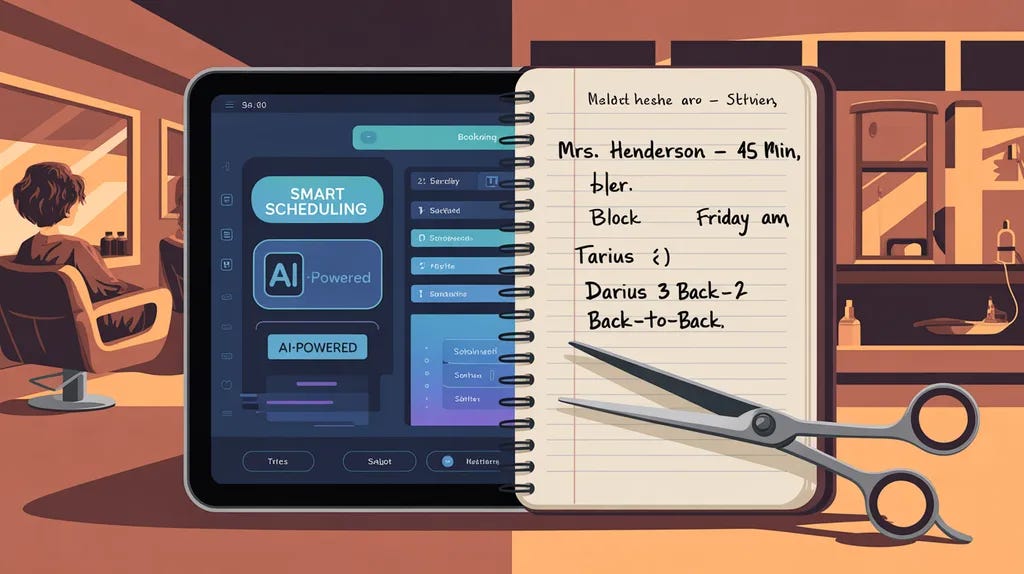
The salon owner bought the booking software in March.
Beautiful pitch. Automated confirmations. Smart scheduling. AI-powered no-show prediction. The demo looked like the future.
She installed it over a weekend and told her senior stylist, Maya, to start using it Monday.
Maya had been there 8 years.
8 years of knowing that Mrs. Henderson always needs 45 minutes, not 30, because she talks through the first 15. That the Thursday 2 PM crowd cancels if they get a reminder text because the text reminds them they CAN cancel. That Darius brings his 2 sons and they all need back-to-back slots or he books somewhere else. That Friday mornings before 10 are dead and should be blocked for walk-ins, not held for appointments that never come.
None of it was in the new software.
By week 2, Mrs. Henderson’s appointments were running over into the next client. Thursday cancellations doubled. Darius couldn’t book 3 back-to-back slots because the system capped consecutive bookings. Friday mornings sat empty with “reserved” slots nobody filled.
Maya started keeping a paper notebook next to the screen. Her actual system. The software was decoration.
The owner saw the notebook and got frustrated. “We paid for this. Use the system.”
Maya didn’t argue. She just started looking for another salon.
8 years of client knowledge walking out the door because the owner bought a tool without asking the person who actually knew the clients.
The software wasn’t broken. The conversation that should have happened before the purchase was.
That’s not a salon story. That’s your agency.
The CRM your setter doesn’t use because it wasn’t built for how they sell. The AI outreach tool that blasts the same sequence to every lead because nobody separated the segments. The automation that fires follow-ups to people who already booked because nothing talks to anything else.
Every tool you bought without asking the person who’d use it daily is Maya’s paper notebook waiting to happen.
Today, I’m showing you:
→ Why 42% of companies abandoned their AI/tool projects last year (and the one mistake they all made first)
→ The one conversation that would have saved months of broken
→ How to know if your next tool purchase is progress or avoidance
Let’s have the conversation…
You’re buying tools to avoid having a conversation…
Not on purpose. But the pattern is the same every time.
Something isn’t working. The pipeline is flat. The setter isn’t converting. The follow-up is inconsistent. The CRM is a mess.
The fix is obvious and uncomfortable: sit down with the person doing the job and ask “what do you actually do? Not what’s in the SOP. What do you ACTUALLY do every day?”
That conversation takes 30 minutes. It’s free. And it would tell you exactly what’s broken.
But it’s uncomfortable. Because the answer might be “the system you built doesn’t work for me.” Or “nobody asked me before setting this up.” Or “I’ve been working around the process you gave me since month 2.”
So instead of having that conversation, you buy something.
New CRM. New outreach tool. New AI platform. New automation. New course on how to set it up. Every purchase feels like progress. Every purchase delays the conversation.
42% of companies abandoned most of their AI initiatives last year. Up from 17% the year before.* 80% of AI projects fail to deliver business value.** The most common reason: “picking the use case before understanding the process underneath it.”***
Translation: they bought the tool before they understood the workflow. They automated what they THOUGHT happened instead of what ACTUALLY happened.
$684 billion spent on AI last year. $547 billion produced zero measurable results.**
Not low results. Zero.
The tool was never the problem. The skipped conversation was.
❌ Before: “The CRM isn’t working. We need to switch to HubSpot.”
✅ After: “The CRM isn’t working. Let’s ask the person using it what they actually need on their screen to move a deal forward.”
Here’s how to stop buying and start asking:
1️⃣ The purchase pause test.
Before you buy, subscribe, or upgrade anything this month, ask one question: “Did the person who will use this tool every day ask for it?”
Not “were they told about it.” Not “were they included in the demo.” Did THEY identify the problem this tool solves? Did the request come from the user or from management?
If the answer is management, you’re buying a solution to a problem defined by someone who doesn’t do the job. That’s how you end up with a booking system that doesn’t know Mrs. Henderson needs 45 minutes.
2️⃣ The 30-minute extraction.
Sit down with the person doing the job. Not the founder. Not the director. The person whose hands are on the keyboard 8 hours a day.
Ask them 5 questions:
→ “Walk me through your actual day. Not the SOP. What you really do.”
→ “Where do you lose the most time?”
→ “What do you work around because the system doesn’t match how you actually work?”
→ “If you could change one thing about how this is set up, what would it be?”
→ “What information do you wish you had on your screen that you don’t?”
Those 5 questions in 30 minutes will tell you more about what’s broken than any vendor demo ever will. And the fix is usually smaller than you think.
It’s not a new platform. It’s a filter. A segment. A field. A permission.
3️⃣ The SOP expiration check.
Pull up your SOPs, your process docs, your onboarding materials. Check the last-modified date.
If it’s more than 6 months old, it’s a time capsule, not a workflow. The person doing the job drifted from it within weeks. They built workarounds you don’t know about. Those workarounds ARE the real workflow. The SOP is a museum exhibit.
If you automate the SOP, you automate fiction. If you buy a tool and configure it based on the SOP, you configure it for a job that doesn’t exist anymore.
Update the SOP by watching the person work. Not by asking the founder what they think happens.
4️⃣ The vendor math reality check.
The vendor promised you a number. Are you hitting it? Are you even tracking it the same way they are?
If the vendor’s numbers don’t match your numbers, the vendor is counting differently.
What counts as a “success” in their dashboard? Is it the same thing you’d call a success? If you don’t know what they’re measuring, you don’t know what you’re paying for.
Ask for the definition before you renew. If the definition doesn’t match your definition of success, the tool isn’t broken. The purchase decision was.
I’ve watched this happen from the inside. I’ve been Maya. Building a workflow by hand over years, watching someone buy a tool that ignores everything I learned, and keeping the paper notebook next to the screen because the system doesn’t work for the person doing the job.
That’s it…
Here’s what you learned today:
→ 42% of companies abandoned their AI/tool projects last year. 80% failed to deliver value. The #1 reason: they automated the process they imagined, not the one that exists.
→ The 30-minute extraction with the person doing the job tells you more than any demo.
→ If the vendor’s numbers don’t match your numbers, ask for the definition before you renew.
Before you buy the next tool, have the conversation. 30 minutes. 5 questions. Free. The answer is already in the building.
Most readers will buy another tool this month and hope it’s the one that fixes the pipeline….
Rainmakers have the conversation first.
Ready to run the extraction?
Today’s Rainmaker mega-prompt runs the purchase pause test, gives you the 5 extraction questions, checks your SOPs for expiration, and audits your last 3 tool purchases against what the user actually needed.
Rainmakers get: The Tool vs. Conversation Audit
✔ List your current tools and who asked for each one
→ which purchases came from users vs. management
→ the conversation that was skipped for each one
✔ The 5 extraction questions, customized to your role
✔ Your SOP expiration dates
✔ The vendor math reality check on your current subscriptions
Loaded skill format: the prompt PLUS your context file, wired to YOUR offer, voice, and proof. Usable in ANY LLM (Claude, ChatGPT, Manus etc)
Readers take notes. Rainmakers book calls.
P.S. Maya kept a paper notebook next to the screen. 8 years of knowing which client needs what, in a spiral notebook, because the software the owner bought didn’t ask her first. Check whether your team has a notebook. If they do, the conversation you need to have is with them, not with a vendor.
P.P.S. If you’re enjoying 8am In Atlanta, send it to someone who’s about to buy a new tool without asking the person who’ll use it every day. The 30-minute conversation is free. The tool isn’t.
---
Sources
*S&P Global. 2025 survey of 1,000+ enterprises. 42% abandoned most AI initiatives, up from 17% in 2024.
**RAND Corporation. Analysis of 2,400+ enterprise AI initiatives. 80% failed to deliver business value. $684 billion invested in AI in 2025, $547 billion produced zero measurable results.
***Fluidlabs. “Why 42% of Enterprise AI Projects Failed in 2025.” Most common failure mode: picking the use case before understanding the process underneath it.
