


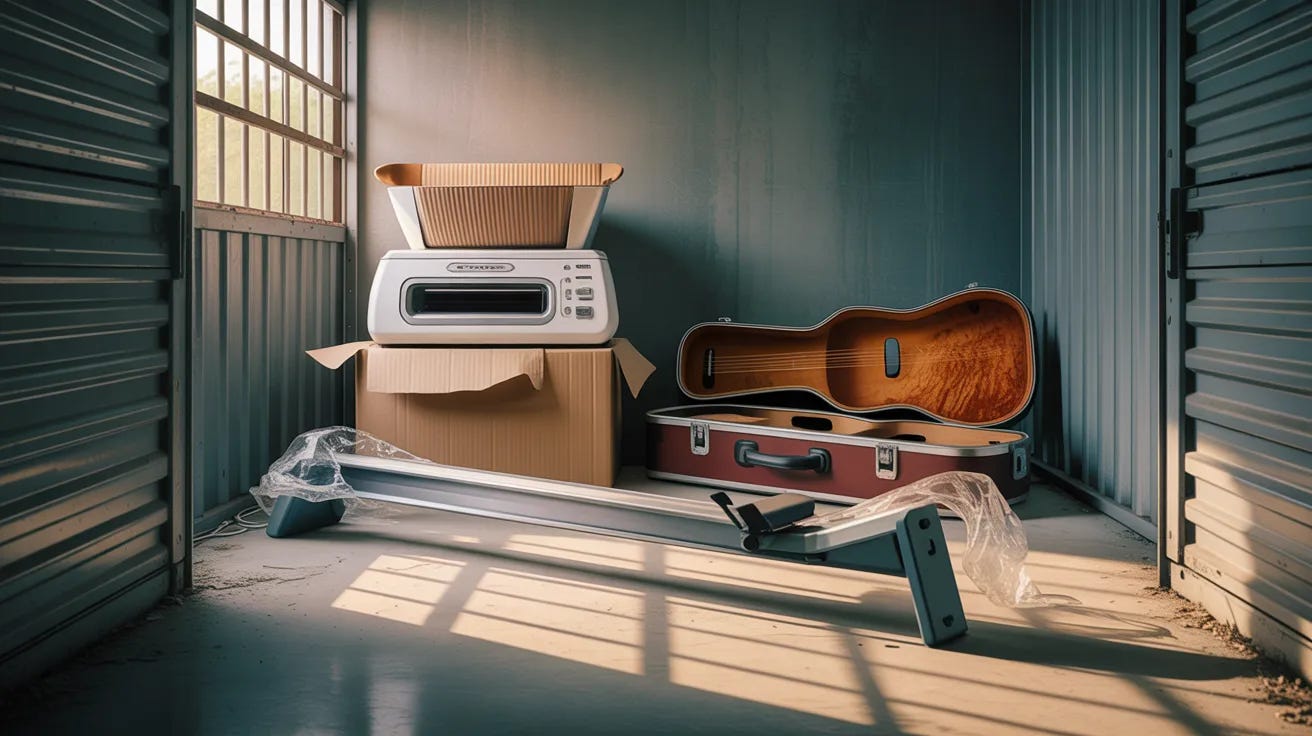
The storage unit was the size of a one-car garage.
The auctioneer was already moving on to the next lot, but I stood there an extra 30 seconds, just … looking.
There was a bread maker in the original box. A guitar in a case, latches rusted shut. A rowing machine still wrapped in plastic film on two of its four legs, like someone got tired halfway through the unboxing and just … stopped.
Whoever rented this unit was a buyer. A really enthusiastic, optimistic, this-is-the-month-I-change-everything buyer.
And somewhere between the purchase and the second Tuesday, the vision fadeed.
You’ve had those moments too.
You’ve gone through your credit card or bank statement, looking for a charge you didn’t recognize.
You found it.
Then you also found 9 others you had forgotten existed. 11subscriptions, 3 of which you hadn’t opened in over 60 days. One you had never used past the setup screen.
The total was $380 a month. $4,560 a year.
Your DM funnel. Your pipeline. Your sell-by-chat process.
It’s another storage unit. Another forgotten subscription. And you’re paying rent on it every single month.
Today, I’m walking through the graveyard. The tools you bought, the dopamine from setting them up, and the slow, quiet way you stopped showing up. And the 3 truths about how this happens, and why it keeps happening. Including:
→ The Saturday afternoon setup ritual, and why it almost always ends by Tuesday
→ What a $47/month CRM and a dusty bread maker have in common
→ The five-second sentence that will change how you see every tool you abandoned
Let’s get into it...
Every tool you bought did exactly what it said it would do.
The CRM organized your leads.
The task manager tracked your follow-ups.
The automation builder connected your forms.
None of them failed at being the product. Something else failed, but it wasn’t the software.
Here are the 3 truths about what actually happened…
1️⃣ The Setup Was the Product
Saturday, 2pm. You found the tool on a podcast ad. You clicked. You signed up. You went through onboarding.
Then you color-coded the pipeline stages. You renamed the columns something that felt very “you.” You added three contacts just to see how it looked.
You closed the laptop feeling productive. Feeling like you built something.
Monday morning, you opened it to add a new lead. It took three clicks longer than you expected. You did it anyway.
Tuesday, you had a DM to respond to. You opened Instagram instead of the CRM because that’s where the DM was. You told yourself you’d log it later.
Wednesday, you forgot it existed.
This is not a character flaw. This is a product design reality that no one talks about honestly.
The setup is fun. It has a beginning, a middle, and an end.
The maintenance has no end. And nobody sells you the maintenance.
❌ “I need a system to organize my leads.” → You buy the tool, do the setup, feel accomplished.
✅ What you actually needed: a system that requires zero extra behavior to stay current with what you’re already doing.
The product you bought was the setup experience. The product you needed was the daily habit.
They charged you for one. They assumed you’d supply the other for free.
2️⃣ Every Abandoned Tool Is a Habit Eulogy
Every tool you abandoned was a promise you made to your future self - that you’d be the kind of person who checks it every day.
You didn’t break that promise out of laziness. That’s how habits work.
Habits require repetition in the same context, at the same time, triggered by the same cue.
Your CRM had none of those things built in. It just sat there waiting for you to remember it existed.
Think about the task manager you bought because you were dropping follow-ups. You paid $19/month for it.
For 3 weeks, you logged every follow-up with a due date and a note. You felt in control.
Then one week you got slammed. You didn’t open the app. The follow-ups stayed in your head instead.
When you came back to the app, there were 14 overdue items staring at you. So you closed it.
You didn’t fail the task manager. The task manager failed to build itself into your existing behavior.
❌ The old story: “I’m just not disciplined enough to maintain a system.”
✅ The honest story: you keep choosing systems that require you to change your entire daily behavior to use them. and you keep being surprised when you don’t.
The abandoned tool isn’t evidence that you’re undisciplined. It’s evidence that the tool was designed for someone who doesn’t have a business to run.
3️⃣ You Don’t Have a Tool Problem
Buying tools feels like progress because it’s concrete.
You have a receipt. You have a login. You have a new tab open. Progress is visible.
Using feels like maintenance because it IS maintenance.
There’s no receipt for showing up to the CRM on a Thursday when you have 17 other things to handle. There’s no dopamine spike for logging a conversation you had two hours ago.
So you keep buying because buying feels like doing. And the graveyard grows.
The tools aren’t the problem. They did exactly what they promised.
What failed was the assumption underneath every purchase.
That you were about to become a different kind of person who does different kinds of things every day … forever.
❌ Buying a new tool to fix a consistency problem you already have.
✅ Diagnosing why your current tools aren’t sticking before spending another dollar.
You have a design problem, not a discipline problem. You keep choosing systems that need you to come to them.
The fix isn’t a better tool. It’s a different kind of tool. One that works with the way you already do.
Ready to audit your own graveyard before you spend another dollar?
Today’s paid member mega-prompt walks you through your personal Tool Graveyard Audit.
A brutally honest inventory of everything you’ve bought, what you promised yourself it would do, and what it actually cost you.
Paid Members Get:
✔ Full Tool Graveyard Audit prompt, catalog every tool with its promise vs. actual use
✔ Monthly cost tracker built into the output so you see the real number
✔ Abandonment timeline map, when did you stop, and what was happening that week?
✔ A categorized list: what to cancel now, what to revisit, what to keep
