


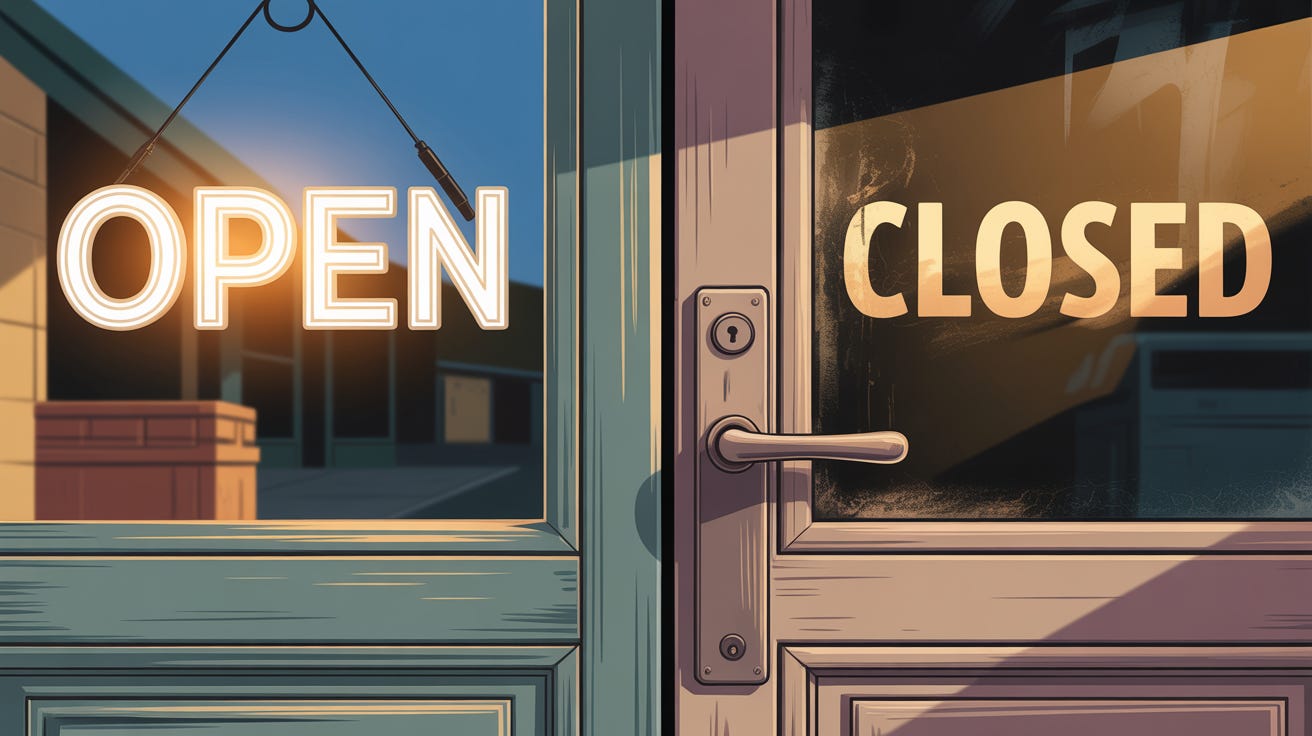
The sign came down on a Tuesday.
The owner had been talking about it for months. The old one was sun-bleached. The second letter had gone crooked sometime around 2019, and you could barely read it from the road anymore.
So he paid for new channel letters. Brushed aluminum. Backlit.
The installers were there before 8 and gone by noon.
He stood across the street to look at it.
It was beautiful.
Then he walked back over, put his key in the front door, and had to jiggle it the way he always did.
Twice. Then lift. Then turn.
His wife had been telling him about that lock for 2 years.
Customers would pull the handle, feel it stick, and about 1 in 5 would let go and keep walking. She watched it happen from the register. She told him. More than once.
He spent $4,000 on the part of the store people could see from the road.
The lock cost $90 and 20 minutes.
He didn’t fix the store. He fixed the part of the store he could see.
That’s your offer.
You rewrote it 3 times this quarter.
New headline. New price. Moved the bonuses around. Added a guarantee, then softened the guarantee. Opened a competitor’s page in another tab to see how they were wording theirs.
Nothing moved.
And every one of those rewrites came with a story attached, because if fixing the offer didn’t work, something deeper must be broken.
You’re not fixing the business. You’re editing the only file you have open.
Today, I’m showing you:
→ Why the offer absorbs blame for 4 failures that have nothing to do with it
→ The 4-point sort that finds the column actually breaking, in one afternoon
→ The one signal that means your offer really is the problem
Let’s sort the pile...
You’re rewriting the only part of the business you can read…
You can open your offer right now. It’s a document. You wrote it. You can change a word in it this afternoon and feel like you did something.
The other 4 places your revenue breaks are invisible from where you sit.
1️⃣ Demand lives in whether the right people are even arriving.
2️⃣ Message lives in what your setter says at 2pm on a Thursday when nobody is watching.
3️⃣ Speed lives in the gap between a reply landing and a human answering it.
4️⃣ Follow-up lives in a thread that went quiet 3 weeks ago and nobody has opened since.
None of those are documents. All of them are behavior.
So when the numbers stop, you reach for the one thing you can fix in a Google doc.
Corporate Visions analyzed more than 100,000 B2B purchase decisions.
Sellers and buyers give different reasons for the same lost deal 50 to 70% of the time.*
Sellers say price. Sellers say features. Buyers say poor discovery, no differentiation, and slow response times.
Clozd compared CRM loss reasons against direct buyer feedback across thousands of deals. The closed-lost reason in the CRM is wrong 85% of the time.**
And 53% of buyers say the vendor who lost could have won, if not for a fixable misstep during the process.***
Read those 3 numbers together.
The seller blames the offer. The buyer names the conversation and the clock.
More than half of those losses were winnable.
The offer was never the problem. The sort you skipped was.
6 months from now, same offer, 4th rewrite, same 3 leads. The only thing that grew is the version number on the sales page.
❌ Before: “I think the offer’s too expensive. Or the positioning is off. Let me look at how the other guys are wording theirs.”
✅ After: “Nobody has replied in the demand column in 11 days. That’s not an offer problem. That’s a top-of-funnel problem and I’ve been editing a sales page about it.”
The second one takes 20 minutes to reach and it’s the one that’s actually moves the needle forward.
Here’s how to run the 4-point sort:
4 questions. One afternoon. Before you touch a single word of your offer.
1️⃣ Count the conversations, not the leads.
How many net-new qualified conversations started in the last 30 days?
Not leads. Not opt-ins. Not form fills. Conversations where a human replied with more than one word.
If that number is low, you’re not converting badly. You’re not converting at all.
Rewriting the offer here is rearranging chairs in an empty room.
2️⃣ Read the actual first message. Word for word.
Don’t ask your setter or your VA what they send. Ask for a screenshot. Ask for 5.
I have never once had this go the way the founder expected.
What you’ll often find is every message doing the same job. 7 versions of “can we hop on a call.”
The rewrite you needed was here, not on the sales page.
❌ “Hey [name], loved your content. Open to a quick chat about scaling?”
✅ “You’re running 3 webinars a month and the replay page has no capture on it. Is that on purpose or was it setup that way from the first webinar and you just never changed it?”
One of those earns attention. The other is the 400th of its kind that week.
A client’s sequence was 7 messages doing 1 job. We cut it to 4, each doing something different. First send to signed was about 2 weeks and $15K. The client told him he was the first person he’d ever responded to from cold outreach.
3️⃣ Check the clock, not the calendar.
How long between a reply landing and a human answering it?
Pick 10 threads from last week. Look at the timestamps.
35 to 50% of sales go to whoever responds first.****
That number gets quoted at you constantly, usually by someone selling you a chatbot.
Be careful here, because the fix isn’t what you think. The answer isn’t a 5-minute response rule for your humans. The answer is that the first touch should be a machine’s job, so a human’s hours stay pointed at follow-up, which is where the bookings, and revenue, actually come from.
4️⃣ Count the touches after the silence.
How many touches does a conversation get before it’s abandoned?
Open your CRM. Find 10 threads that went quiet. Count the messages after the last reply.
48% of salespeople never make a single follow-up attempt after the first contact.*****
And 1 in 10 deals sitting in your CRM marked “lost” has a buyer who was still actively considering you when you closed the conversation.**
This is the one that’s broken in almost every business I look at. Most operations quit at 1 or 2. Every stall abandoned at touch 2 is 4 figures walking out the door with a polite goodbye attached,.
Steal the sort. Run it on a client. Run it on your own funnel tonight. You don’t need me involved to ask 4 questions.
Here’s what looking actually does…
I coached a setter who had gone a full week with zero sets.
Not low. Zero.
Her end-of-day reports were clean. Right number of conversations logged, right number of touches, everything filled in the way it was supposed to be.
Confused, I decided to stop reading the reports and opened the conversations.
She was doing everything right up until the moment somebody said they couldn’t afford it. Then she’d say something kind, close the thread, and move to the next lead.
Every single time.
I gave her one thing to say instead. Word for word.
Zero sets became 1. Then 2. Then 3.
Same offer. Same price. Same leads. Same setter.
The one time the offer really is the problem
I’d be lying if I said the offer is never it.
Here’s the signal, and it isn’t a low close rate.
The offer is the problem when people who are fully qualified, fully engaged, and clearly able to pay consistently reach the end and say no. Not stall. Not ghost. Say ‘NO’, out loud, with a reason.
That’s an offer problem. Everything else in the pile is one of the other 4.
That’s it…
Here’s what you learned today:
→ Sellers and buyers name different reasons for the same lost deal 50 to 70% of the time. Sellers say price. Buyers say discovery and speed.
→ Run the 4-point sort before you rewrite a word. Demand, message, speed, follow-up. One afternoon.
→ Fully qualified people saying an actual out-loud no is the only real offer signal.
A rewrite you can’t measure is a guess.
A guess you repeat is a habit.
A habit that costs you leads is a leak.
Leaks close when somebody looks.
Most readers will finish this, agree with it, and go back to editing the sales page anyway…
Rainmakers open the conversations first.
Ready to run the sort?
Today’s Rainmaker mega-prompt counts your net-new conversations, reads your actual first messages, clocks your response gap, counts your touches after silence, and names the one column to fix this week.
Rainmakers get: The 4-Point Sort Audit
✔ Paste your last 30 days of conversations, messages, and timestamps
→ your 4 column scores, calculated
→ the one column that’s actually failing
✔ Your first-message audit: every job each message is doing, and the duplicates
✔ Your response gap, measured against the first-responder threshold
✔ Your abandonment count and what the dead pile is worth
✔ The offer-problem test, run honestly, so you know whether to rewrite or not
Loaded skill format: the prompt PLUS your context file, wired to YOUR offer, voice, and proof. Usable in ANY LLM (Claude, ChatGPT, Manus etc)
Readers take notes. Rainmakers book calls.
P.S. The sign owner did eventually fix the lock. His wife took the $90 out of the register and had it done on a Wednesday while he was out. He noticed on Friday. The door just opened. Check which part of your business you’ve been standing across the street admiring.
P.P.S. If you’re enjoying 8am In Atlanta, send it to someone who’s rewriting their offer this week. They’ll get the same strategies behind $4.5M in cash collected in 34 months.
—
Sources
* Corporate Visions. Analysis of 100,000+ B2B purchase decisions. Sellers and buyers cite different reasons for deal outcomes 50 to 70% of the time. Sellers over-index on price and missing features; buyers cite poor needs discovery, lack of differentiation, and slow response times.
** Clozd. CRM loss reasons compared against direct buyer feedback across thousands of deals. Closed-lost reason in CRM inaccurate 85% of the time; listed competitor wrong 65% of the time; 1 in 10 deals marked “lost” had a buyer still actively considering the vendor.
*** Corporate Visions. 53% of buyers say the losing vendor could have won if not for a fixable misstep during the sales process.
**** XANT research. 35 to 50% of sales go to the vendor that responds first. Widely corroborated across SPOTIO and Invesp 2026 benchmark compilations.
***** Invesp / Martal 2026 compilations. 48% of salespeople never make a single follow-up attempt after initial contact. Related: 95% of converted leads are reached by the 6th attempt, yet only 10% of reps make more than 3.
Note: the widely circulated “80% of sales require 5 follow-ups” stat is deliberately excluded. SPOTIO flags its original attribution to the National Sales Executive Association as never independently verified.
